
AI in hospitality reaches a tipping point – 2026 may define the industry's future
The coming months may separate hotels adopting AI from those falling behind.
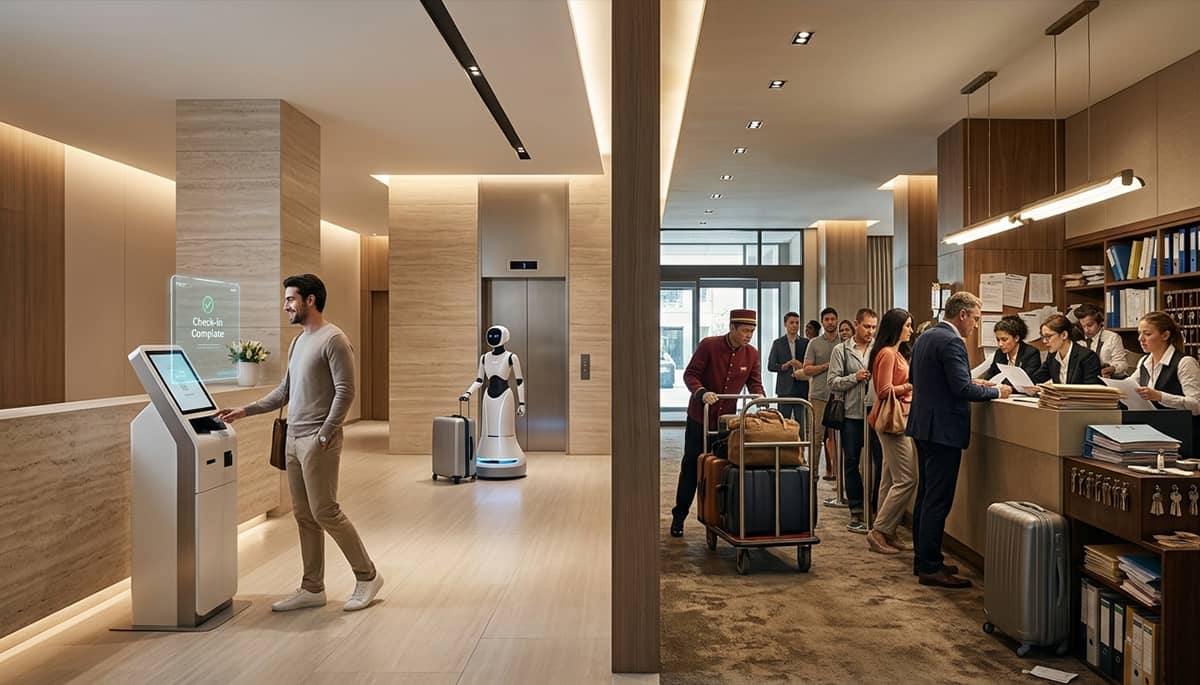
Table of contents
Introduction
For years, AI in hospitality has been described as “the future.” The problem is that for many hotels, that future never truly materialized.
That is now changing. AI is no longer an experiment — it is becoming a requirement to stay competitive. We are entering a phase where differences between hotels will no longer be defined only by location or standard, but by how effectively they use technology across operations and guest experience.
2026 may become the moment when the market clearly splits:
- into hotels that build a competitive advantage with AI,
- and those that remain dependent on manual processes and start losing ground.
Example
Aleksandra manages a business hotel in a major city. A year ago, her team manually handled most guest inquiries, updated pricing once per day, and relied heavily on experience for decision-making.
Today, a competing hotel in the same area operates very differently:
- prices are updated dynamically in real time,
- guest inquiries are handled by AI 24/7,
- systems analyze data from PMS, CRM, and distribution channels to suggest operational decisions.
The result?
This is not just about technology. It is about speed of execution.
Aleksandra’s hotel begins to fall behind:
- slower response times,
- delayed pricing adjustments,
- more frequent operational errors.
Each individual gap seems small.
Over the course of a month, they turn into measurable losses.
What is actually changing
The biggest shift is not the emergence of new tools. It is the transformation of the hotel into a data-driven operating system.
AI is starting to:
- automate repetitive processes,
- support operational decisions,
- unify data across systems,
- operate in real time.
This moves hotels from a:
- reactive model (waiting for problems),
- to a proactive and predictive model.
In practice, this means hotels no longer just respond to guest needs —
they anticipate them.
Why 2026 is a decisive moment
AI technologies have existed for years, but three key factors are now converging:
1. Technology maturity
AI is no longer experimental. Systems are:
- more stable,
- easier to integrate,
- usable in day-to-day operations.
2. Market pressure
Guest expectations are evolving rapidly:
- immediate responses,
- personalization,
- seamless experiences.
Hotels that cannot deliver this become less competitive, even with a strong product.
3. The growing gap between hotels
The most critical factor is adoption speed.
- Hotels implementing AI are becoming faster and more efficient.
- Hotels without AI are not just standing still — they are falling behind relative to the market.
This makes 2026 more than just another year.
It is the moment when structural separation in the market begins.
Where AI impacts hotels in practice
The real value of AI does not come from individual features, but from its impact across the entire hotel operation.
Operations
AI fundamentally changes how operational teams work.
Key effects include:
- Automated communication – a significant portion of guest inquiries can be handled without human involvement, reducing pressure on front desk teams and improving response times.
- Better team coordination – data is no longer scattered across chats and notes but centralized within systems.
- Fewer operational errors – systems can detect inconsistencies and trigger reminders.
In practice, this leads to more predictable and less chaotic operations.
Finance / revenue
AI directly influences revenue performance.
Key mechanisms:
- Real-time dynamic pricing – rates respond instantly to demand, events, and user behavior.
- Data-driven decisions – decisions are based on analysis rather than intuition.
- Channel optimization – systems can suggest where to increase availability or investment.
The result: higher revenue from the same inventory.
Guest experience
This is where the impact becomes most visible to guests.
AI enables:
- Instant communication – no waiting for responses.
- Personalization – offers tailored to guest preferences.
- Consistency across channels – seamless experience regardless of touchpoint.
For the guest, this translates into a simple perception: the hotel “understands” them.
Team / HR
AI does not replace teams — it reshapes their role.
Key changes:
- Less manual work – fewer repetitive tasks.
- More decision-making responsibility – greater focus on analysis and management.
- Reduced operational stress – fewer unexpected issues and disruptions.
This can lead to improved retention and overall team performance.
Technology / IT
AI implementation changes the hotel’s technology architecture.
Critical components include:
- System integrations – PMS, CRM, channel managers, communication tools.
- Data centralization – a single source of truth.
- New skill requirements – teams need to understand data and tools.
Without this foundation, AI cannot deliver meaningful results.
What is blocking transformation
Despite the availability of technology, many hotels still struggle to implement AI effectively.
The most common barriers include:
- Lack of strategy – disconnected, point-based implementations.
- Fragmented systems – lack of integration prevents data utilization.
- Team resistance – fear of change or job displacement.
- Underestimating the shift – treating AI as a tool rather than an operating model transformation.
As a result, hotels invest in technology but fail to see real impact.
How to approach implementation
The key is to take a systemic, not tactical approach.
Effective direction includes:
- Start with processes, not tools – define what needs to be improved first.
- Centralize data – without it, AI has nothing to operate on.
- Implement in stages – gradual rollout instead of one large transformation.
- Train the team – mindset change is as important as technology.
Most importantly: AI is not an IT project. It is a transformation of how the hotel operates.
Summary
2026 may mark the moment when hospitality fully enters the AI era.
Key takeaways:
- AI is no longer optional — it is becoming the standard.
- Competitive differences will be driven by data and automation capabilities.
- The biggest risk is not failure in implementation, but inaction.
In practical terms:
Hotels that act now will build an advantage.
Those that wait will lose it.

Michał Szymański
Co-founder of technology companies MDBootstrap and CogniVis AI / Creator of Longevity-Protocols.com / Listed in Forbes '30 under 30' / EOer / Enthusiast of open-source projects, fascinated by the intersection of technology and longevity / Dancer, nerd and bookworm /
In the past, a youth educator in orphanages and correctional facilities.