
Hotel procurement automation: less chaos, higher margin and financial control
Manual procurement is not just an administrative issue for hotels. It is a real risk to margin, cash flow, cost control and operational consistency.
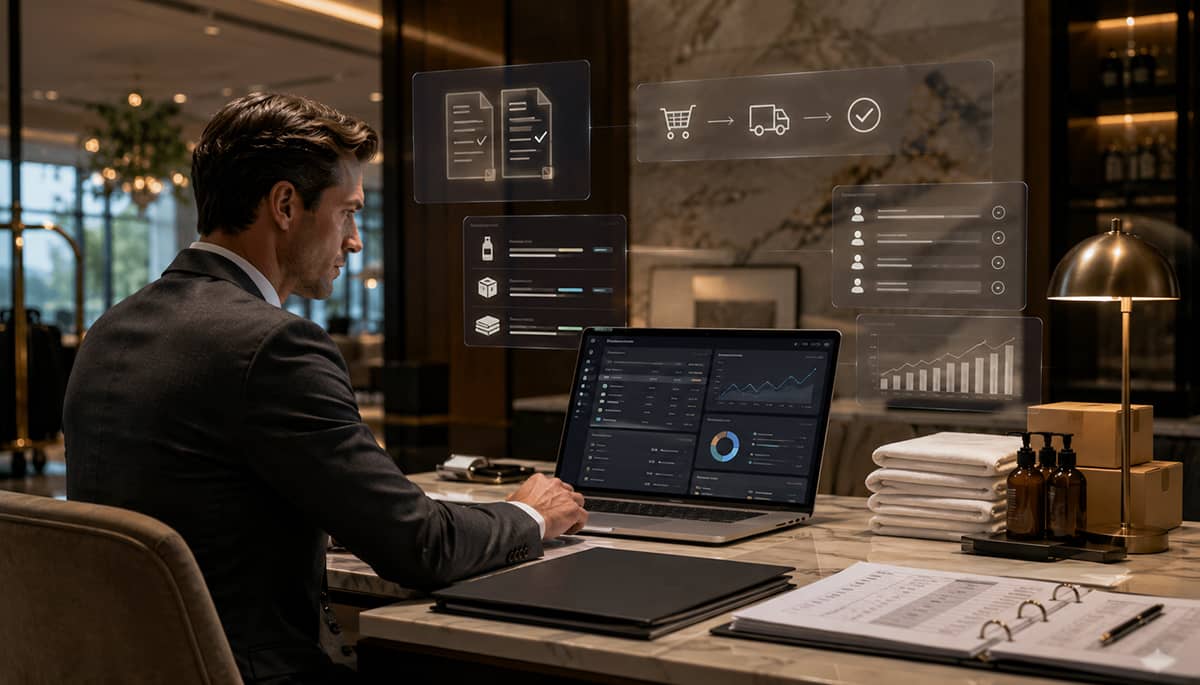
Table of contents
Introduction
Hotels talk a lot about revenue, occupancy, room rates and revenue management strategy. That makes sense. Revenue is visible every day. Teams can track pickup, ADR, RevPAR, cancellations and booking pace almost in real time. But the other side of the equation often receives less attention: operating spend created every day in the kitchen, housekeeping, maintenance, spa, F&B, administration and across the entire hotel group.
For years, procurement in many hotels was treated as a back-office function. Someone raises a need, someone sends an email, someone approves a purchase, someone receives the invoice, and finance later tries to match everything to the budget. The problem is that in an environment of rising costs, wage pressure, unstable supplier pricing and tight margins, this model is no longer harmless. Manual procurement does not only slow teams down. It weakens financial control.
The biggest risk is not always one major mistake. More often, it is the accumulation of small inconsistencies: a purchase made outside the process, a local supplier charging a different price than the group contract, an invoice approved too late, a budget overrun discovered after the fact, or delayed data reaching the finance team. Each of these issues can look minor on its own. Together, they create a system where management sees the impact only after the money has already been spent.
Procurement automation is therefore not just about “digitizing purchase orders.” Its real value is that it moves the hotel from a reactive model to a controlled one. Instead of discovering a problem after month-end close, the hotel can detect a deviation at the moment a purchase request is made. Instead of relying on emails and spreadsheets, it can work with one process, one source of data and clear approval rules.
Example
Elena manages operations at a resort hotel with a large F&B operation, spa facilities and a seasonal team that grows significantly during peak periods. On paper, the purchasing process is simple: department heads submit requests, larger orders are approved by the operations director, finance processes invoices, and the owner receives a monthly cost report.
In practice, the process works very differently. The executive chef orders some products directly from a supplier because otherwise the kitchen will not be ready for the weekend. Housekeeping buys cleaning supplies from a local vendor because the preferred supplier is delayed. The maintenance manager sends a photo of a replacement part to reception, reception forwards it to administration, administration asks for a price, and two weeks later an invoice arrives with a description that nobody can immediately connect to a specific request.
Nobody is trying to create a problem. Everyone is trying to keep the hotel running. But the hotel gradually starts managing procurement through exceptions. When Elena reviews the monthly result, she sees overruns in several cost categories. What she cannot quickly answer is far more important: which costs were planned, which were urgent, which were caused by seasonality, and which resulted from weak purchasing discipline.
This is the real problem with manual procurement. A hotel may have a capable team, good intentions and formal procedures, but if the actual process runs through emails, phone calls, spreadsheets and local workarounds, cost control is always late. Automation does not replace management decisions. It gives those decisions context, data and the right moment to act.
Why manual purchasing erodes margin
Hotel margin does not disappear only because room rates are too low. It often disappears quietly through daily purchasing decisions that are not visible to management in real time. This matters especially in properties with multiple departments, multiple locations or a high share of variable operating costs.
Manual procurement is risky because it creates the illusion of control. The hotel may have procedures, budgets and responsible managers, but the actual flow of information remains fragmented. Requests sit in emails, confirmations in messages, invoices in a separate system, and financial data appears only later. As a result, cost control becomes a rear-view mirror exercise.
The most common sources of margin leakage are very practical:
-
Purchases made outside agreed commercial terms prevent the hotel from using its real buying power. If each department or property orders independently, the group may lose volume discounts and negotiate weaker conditions than it should.
-
Delayed approvals lead to urgent purchases, which are often more expensive and less predictable. When teams do not get decisions in time, they start looking for shortcuts, and shortcuts almost always reduce financial control.
-
Lack of current budget visibility means overruns are detected too late. If a manager discovers the problem only after the invoice has been posted, they are no longer managing the cost. They are explaining its consequences.
-
Manual data entry increases the risk of errors, especially when the hotel handles many invoices, suppliers and cost categories. A mistake in a purchase order number, price, quantity or cost center can distort reporting and extend the month-end process.
-
No consistent decision trail makes audits and accountability harder. If it is unclear who approved a purchase, why it was approved and whether it was aligned with budget, the hotel loses transparency that is critical for owners, investors and finance teams.
The most difficult part is that these costs rarely appear as one clear line item in the profit and loss statement. There is no row called “cost of purchasing chaos.” Instead, the hotel sees higher prices, more administrative work, delayed reporting, weaker supplier terms and less reliable budget control.
Where purchasing chaos starts
Purchasing chaos usually does not start in one place. It appears at the intersection of departments, systems and decisions. In a hotel, every department works at a different rhythm: the kitchen reacts to occupancy and events, housekeeping reacts to room turnover, maintenance reacts to failures, spa reacts to product consumption, and finance works around reporting cycles. If procurement does not connect these rhythms into one process, the hotel starts operating in several parallel versions of reality.
The most common friction points appear across the purchasing process:
-
Purchase requests do not follow a standard format, so every department describes needs differently. One person sends an email, another sends a photo, a third person enters something into a spreadsheet, and someone else calls the supplier directly. This makes later comparison, approval and budget control much harder.
-
Approvals depend on the availability of specific people, instead of a clear workflow. If the director, owner or department head does not respond quickly, the process stops. The operational team then either waits or bypasses the procedure because the hotel still needs to run.
-
Suppliers are managed locally rather than strategically, which means different properties may use different prices, payment terms and service standards. In hotel groups, this creates a situation where scale does not translate into better purchasing conditions.
-
Invoices arrive after the process rather than as part of the process, so finance often has to reconstruct the history of a purchase. If an invoice does not match the order, it is not immediately clear whether the issue is price, quantity, delivery scope or missing approval.
-
Reporting is disconnected from daily decisions, so managers see costs only when they can no longer influence them. This is especially dangerous in fast-moving categories such as food, energy, operating supplies, outsourced services and maintenance.
The hotel loses something more important than administrative time. It loses continuous control. And in an industry where margins are sensitive to seasonality, cost inflation and demand volatility, weak continuous control can quickly affect financial performance.
What procurement automation changes
Procurement automation does not mean the hotel stops making purchasing decisions. It means those decisions happen in a structured environment: with budgets, approval paths, supplier catalogs, price history, documentation and financial integration.
The biggest change is that control moves earlier in the process. In a manual model, finance often sees the cost after the fact. In an automated model, the cost becomes visible at the request stage, before it turns into an order, a delivery and an invoice. That difference matters because it allows the hotel to manage spending while there is still time to change it.
Procurement automation usually includes several core elements:
-
Centralized purchase requests organize the very first step of the process. A team member or manager does not send a loose message. They create a request in the system, assigned to a category, department, budget and property.
-
Automated approval workflows route requests to the right person based on value, category, department or location. This removes the need to manually decide who should approve each purchase.
-
Approved supplier catalogs reduce purchases made outside agreed terms. Operational teams can still order quickly, but they do so within negotiated prices, contracts and rules.
-
Matching invoices with orders and deliveries reduces the risk of overpayments, errors and unauthorized costs. If an invoice does not match the purchase order, the system can flag the exception before the issue moves further into finance.
-
Integration with accounting or ERP systems allows finance to work with current data without manual re-entry. This shortens month-end close and improves the quality of management reporting.
In practice, good automation should not become another layer of bureaucracy. It should remove friction while strengthening discipline. Operational teams should be able to order faster, finance should see more, and management should make decisions based on current data rather than reconstructing events from several weeks ago.
The practical impact on hotel operations
Procurement automation is a financial topic, but its effects are visible across the entire hotel. This matters because if the project is positioned only as a “finance tool,” operational teams may see it as another administrative burden. In reality, well-designed procurement affects work pace, product availability, supplier relationships, guest experience and management decisions.
Operations
For operations, continuity is everything. A hotel cannot afford to run out of critical products, spare parts or supplies because an approval is stuck in someone’s inbox.
Automation supports operations in several ways:
-
Teams can see order status faster, so they do not need to send follow-up emails asking whether a purchase has been approved. This reduces noise and allows managers to focus on guests and staff.
-
Repeat purchases can be standardized, which limits improvisation. Housekeeping, F&B and maintenance teams can use approved products and suppliers instead of rebuilding the process every time.
-
Exceptions become easier to identify, so urgent purchases do not disappear into operational chaos. If something must be bought outside the standard path, the system can capture it, explain it and later use that information to improve planning.
Finance and margin
For finance, automation primarily means earlier visibility. It changes the role of finance from a team that explains the past into a partner that helps control future spending.
The key financial effects are clear:
-
Budgets can be controlled before money is spent, not only after an invoice has been posted. This allows the hotel to stop, adjust or challenge a purchase before it affects the monthly result.
-
Purchasing data becomes more consistent, because categories, suppliers, properties and cost centers are assigned within one process. Reporting becomes less dependent on manual corrections.
-
The hotel can use its negotiating power more effectively, especially in multi-property groups. When management sees the full purchasing volume by supplier and category, it can negotiate based on real data rather than fragmented spreadsheets.
Guest experience
At first glance, procurement may seem far removed from guest experience. In reality, it is much closer than it appears. Missing products, delayed deliveries, low-quality substitutes or unresolved maintenance issues can quickly become visible to guests.
Automation affects guest experience indirectly but concretely:
-
It reduces the risk of operational shortages, because requests are planned and approved more effectively. This is particularly important in peak season, during events and in properties with complex F&B operations.
-
It helps maintain standard consistency, because departments and properties use approved suppliers and products. Guests do not see the procurement system, but they feel the consequences of consistency or inconsistency.
-
It makes it easier to respond to quality issues, because the hotel has a clearer history of purchases, suppliers and problems. If a product or supplier repeatedly causes issues, the pattern is easier to detect and address.
Team accountability
Manual procurement often creates tension between departments. Operations accuse finance of slowing things down, finance accuses operations of poor discipline, and management sees budget overruns without enough context. Automation does not remove every conflict, but it makes accountability clearer.
For the team, this creates several benefits:
-
Rules become more transparent, because everyone knows when approval is needed, who is responsible and what the current status is. This reduces informal arrangements that are difficult to track later.
-
Department managers gain better control over their own costs, because they see requests and budget usage closer to the decision point. Accountability becomes operational rather than abstract.
-
Administration and finance spend less time reconstructing what happened, because documents are connected to the process. Less time is spent searching emails, explaining invoices and matching information after the fact.
Management decisions
At management level, procurement is one of the most valuable sources of insight into how the hotel really operates. It shows where costs are rising, which departments generate the most exceptions, which suppliers are strategic and where processes need improvement.
A mature procurement process gives management information that can support real decisions:
-
Is the problem price, volume or purchasing discipline? Without reliable data, it is easy to draw the wrong conclusion. Automation helps separate market-driven cost increases from process-driven cost leakage.
-
Which cost categories need renegotiation? If the hotel can see purchasing trends over time, it can prepare supplier conversations earlier and look for alternatives before pressure becomes urgent.
-
Where does the process slow operations down? If approvals regularly block specific types of purchases, the problem may not be the team. It may be an approval workflow that no longer fits operational reality.
How to choose a procurement system
Choosing a procurement system should not start with a feature checklist. It should start with a more practical question: where is the hotel losing control today? An independent boutique hotel, a resort with complex F&B and a group managing multiple properties will not have the same priorities.
The most important selection criteria should be evaluated in operational terms:
-
Integration with finance and accounting is critical because procurement without financial integration can quickly become another silo. The system should reduce manual data entry and support consistent cost reporting.
-
Flexible approval workflows allow the process to match the hotel’s real structure. Different thresholds may apply to F&B, maintenance, capital expenditure, operating supplies and services.
-
Multi-property support matters for hotel groups that need both central control and local flexibility. Headquarters should see the full picture, but each property must still operate at the speed its daily work requires.
-
Ease of use for operational teams determines adoption. If the system is too heavy, employees will return to emails, phone calls and spreadsheets, leaving the hotel with only a digital façade of control.
-
Supplier and product catalogs help maintain purchasing consistency. This is especially important where product standards influence service standards, such as housekeeping, F&B, spa and maintenance.
-
Reporting and analytics should show not only how much the hotel spends, but why it spends, where deviations appear and which decisions need improvement. A dashboard alone is not enough if it does not support management action.
Hotels should also be cautious with systems that promise full control but require too much behavioral change from day one. In hospitality, technology must fit operational reality. If reception, F&B, housekeeping and maintenance teams do not use the system, even the strongest finance functionality will not deliver the expected impact.
How to implement automation without slowing operations
The biggest mistake in procurement automation is treating it as a purely technical project. In reality, it changes how purchasing decisions are made. It affects responsibility, budgets, supplier relationships and daily team habits.
That is why implementation should be staged. The hotel does not need to automate everything at once. It is usually better to begin with areas where purchasing chaos is either most expensive or most repetitive.
A practical implementation plan may include the following steps:
-
Map the current purchasing process first, without assuming that procedures on paper reflect how work actually happens. The hotel needs to see where requests really start, who approves them, where information gets lost and which exceptions have become routine.
-
Select a few pilot categories, instead of trying to cover the entire hotel immediately. Good starting points may include repeat operating purchases, selected F&B categories, cleaning supplies, consumables or specific maintenance services.
-
Set simple approval thresholds, so control does not kill operational speed. If every small purchase requires multi-level approval, teams will look for workarounds. Control must be proportional to purchase value and risk.
-
Involve operational managers in the design, because they know where the process may break. Automation imposed only by finance may be formally correct but impractical in daily hotel operations.
-
Measure outcomes after implementation, not just system usage. The hotel should track approval time, number of exceptions, budget deviations, share of spend with approved suppliers, data quality and administrative workload.
Procurement automation works best when it is connected to a clear purchasing policy. The system alone will not solve the problem if the hotel has not defined who can buy, within what limits, from which suppliers and under what circumstances exceptions are allowed. Technology strengthens the process, but it does not replace management rules.
Summary
Procurement in hospitality is no longer a back-office administrative function. In an environment of cost pressure, increasing owner expectations and growing operational complexity, it is becoming one of the key tools for protecting margin.
Manual purchasing may seem flexible, but often it is only superficially flexible. It helps solve individual problems quickly, while creating weak visibility, fragmented data, delayed reporting and a higher risk of uncontrolled spending. This is especially dangerous in hotels, where many small cost decisions accumulate into the financial result of the entire month.
Procurement automation gives hotels three things that emails and spreadsheets cannot provide reliably: structure, current visibility and accountability. It helps control budgets, use negotiated supplier terms, reduce invoice errors and detect deviations earlier.
The most important point, however, is not the system itself. It is the shift in management mindset. Procurement should not be the place where the hotel explains spending after the fact. It should be the process that helps teams make better decisions before the money is spent.
For hotels and resorts that want to improve profitability not only by increasing revenue but also by controlling costs more intelligently, procurement automation is becoming less of an optional upgrade and more of a core element of mature operational management.

Michał Szymański
Co-founder of technology companies MDBootstrap and CogniVis AI / Creator of Longevity-Protocols.com / Listed in Forbes '30 under 30' / EOer / Enthusiast of open-source projects, fascinated by the intersection of technology and longevity / Dancer, nerd and bookworm /
In the past, a youth educator in orphanages and correctional facilities.