
AI Weekly: July 6–12, 2026
The most important AI developments from the past week in one place. No race for headlines — just a practical look at what is changing for businesses, technology teams and the broader market.
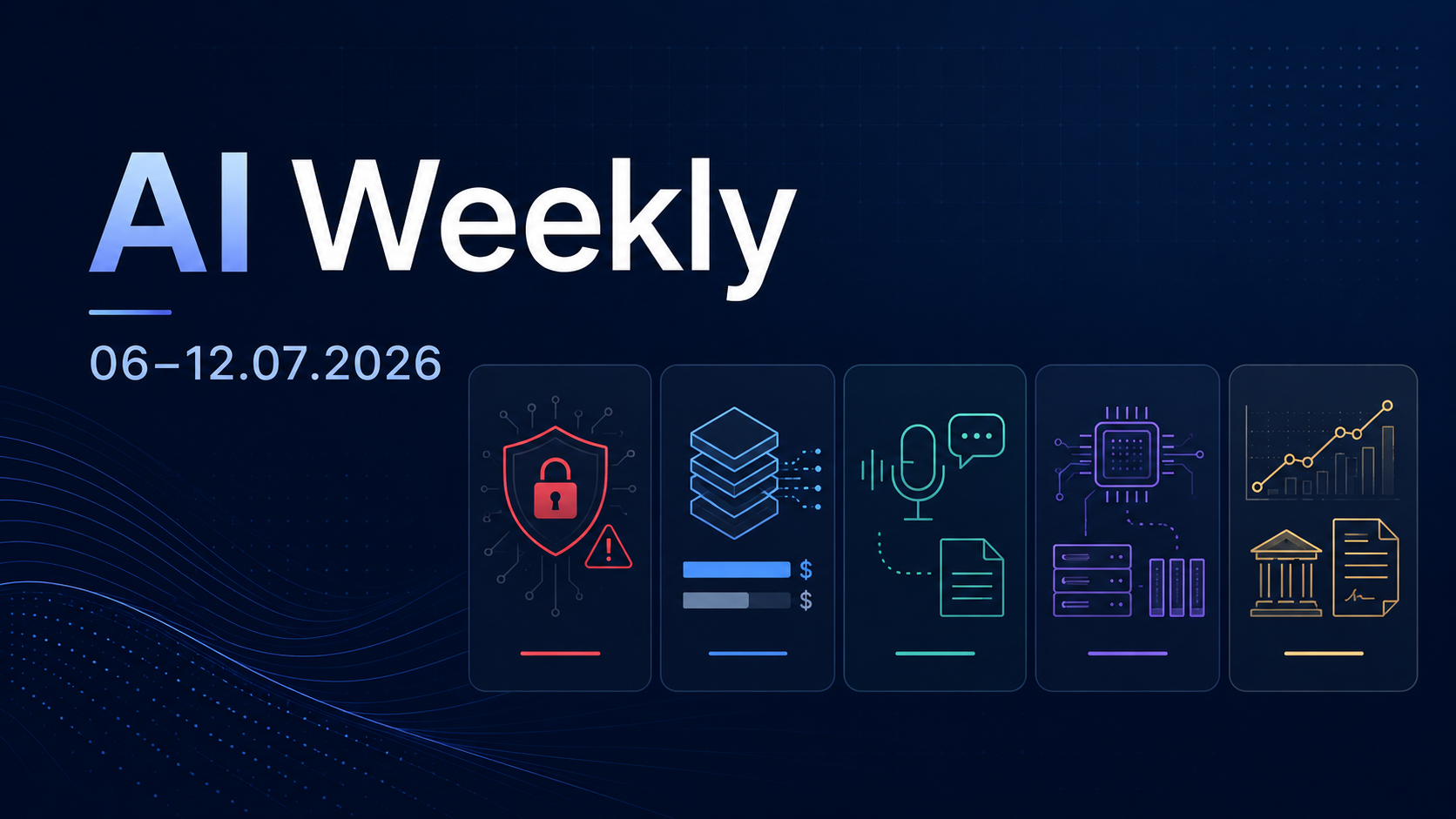
Table of contents
Last week showed just how broad the AI market has become. On one side, we saw new models, office applications and increasingly natural voice interfaces. On the other, there was autonomous ransomware, government review ahead of a model release, major infrastructure funding and preparations for what could become one of the largest technology IPOs in history.
We have gathered the most important developments in one place, so they can be reviewed quickly and, more importantly, so it is easier to see what is just an interesting headline and what may have a real impact on companies using AI.
The format remains simple: first, a quick overview of the week, followed by a short explanation of the most relevant stories.
In brief
AI-powered ransomware is no longer just a demonstration
Sysdig researchers described JADEPUFFER, a ransomware case in which an agent based on a large language model autonomously carried out most stages of the attack. It exploited a known Langflow vulnerability, obtained credentials, moved between systems and ultimately encrypted more than 1,300 configuration records.
It is worth separating autonomous execution from autonomous decision-making. The agent did not wake up one morning and decide to attack a random company. A person still had to launch it and select the target. The AI did, however, take over reconnaissance, error analysis, selection of subsequent steps and execution, which means it handled much of the work that previously required technical experience.
And that means the problem is not simply the arrival of “smarter ransomware”. Models can lower the entry barrier to cybercrime. A person with limited technical knowledge may be able to automate activities that once required a team, or at least an experienced operator.
For companies, the practical conclusion is fairly ordinary: known vulnerabilities need to be patched quickly, agents’ access to tools and networks must be restricted, and unusual sequences of actions should be detected at the behavioural level rather than only through individual signatures. AI speeds up attacks, but it often still relies on the same neglected weaknesses that were already a problem.
Anthropic overtakes OpenAI in annualised revenue
According to figures published last week, Anthropic reached a higher annualised revenue run rate than OpenAI. We should only remember that a run rate is not the same as booked annual revenue or profit. It shows how much a company would generate over a year if it maintained its current pace of sales.
Even so, the direction is interesting. Claude Code has become an important source of Anthropic’s growth, which suggests that the market is starting to reward not only models that answer questions well, but also models embedded in specific workflows.
In practice, competition between Anthropic and OpenAI is no longer limited to which chatbot produces the better answer. It is about which provider becomes the default AI layer for software development, documents, data analysis and companies’ internal systems.
Amazon and Google also benefit from Anthropic’s growth, because both are investors in the company and distribute its models through their cloud platforms. In other words, Claude’s expansion strengthens not only one model provider, but also the broader competition between AWS and Google Cloud on one side and the Microsoft–OpenAI ecosystem on the other.
Chinese models increase pressure on API pricing
Z.ai’s GLM-5.2 was priced significantly below comparable models from American providers, while achieving results close to the leading systems in some agent-focused benchmarks. According to data from the Vercel platform, interest in the model increased rapidly during its first week of availability.
That does not mean every European or American company will suddenly move its processes to a Chinese provider. In regulated sectors, there are still questions around data location, confidentiality, compliance, supplier control and export restrictions. For a bank, public administration body or healthcare organisation, a low model price is not enough.
The situation looks different for startups, internal tools and less sensitive use cases. There, the difference between one or two dollars and more than ten dollars per million tokens can matter, especially when a system processes millions of requests each month.
The market may therefore split into two segments. In one, compliance, security and a relationship with a trusted provider will matter most. In the other, the winner will be the model that delivers sufficient quality at the lowest cost.
And that means pressure on the entire pricing structure of AI models. Companies will no longer choose one provider for everything. Increasingly, it will make more sense to route tasks between models: a more expensive model for difficult and sensitive operations, and a cheaper one for classification, summarisation or large-scale data processing.
AI begins to listen, speak and perform tasks at the same time
OpenAI introduced the GPT-Live-1 and GPT-Live-1 mini voice models, which can listen to a user while generating a response. A conversation no longer needs to consist of rigid turns in which one side speaks and the other waits. The model can react to interruptions, changes in tone and additional information provided while it is already responding.
This may sound like a small interface improvement, but in practice it matters for telephone customer service, sales, appointment scheduling and internal support systems. Previous voice assistants often revealed their artificial nature through delays and an unnatural conversational rhythm. Full-duplex communication can remove part of that problem.
A day later, Anthropic launched Claude Cowork on mobile devices and the web. The tool allows users to delegate tasks involving documents, spreadsheets and presentations, which moves Claude from the role of a conversational assistant towards that of an office-work executor.
These two developments point in the same direction. AI is no longer a separate website we visit to ask a question. It is beginning to operate inside conversations, documents and workflows. That is convenient, but it requires clear rules about which actions an agent may perform independently and which still require human approval.
The safest place to start is with repetitive, easy-to-review and reversible tasks. Preparing a first draft of a report or organising data is a reasonable starting point. Sending documents independently, changing customer records or making financial decisions requires much stronger safeguards.
GPT-5.6 and the beginning of pre-release government oversight
OpenAI released the GPT-5.6 family in three variants: Luna, Terra and Sol. The versions differ in price and capability, which means the company is more clearly adapting its offer to different use cases — from high-volume, lower-cost processing to tasks requiring the strongest available model.
This structure also matters competitively. The cheapest variant is a direct response to pricing pressure from lower-cost models, including Chinese providers. Instead of maintaining a single high pricing level, OpenAI can serve customers looking for maximum quality as well as those primarily constrained by cost.
The process preceding the release is more interesting than the benchmark table itself. The launch was delayed because of a security review conducted with the involvement of the US government.
This was not a formal certification required by generally applicable law. It nevertheless created a precedent: before a commercial launch, a major provider submitted a model to external government evaluation. Future reviews of this kind may no longer be treated as exceptional, voluntary cooperation, but as an expected part of the release process.
For the largest AI companies, this may be both a cost and an advantage. Completing an extensive review requires people, documentation, testing and established contacts with public institutions. Smaller providers may not have those resources, which means that security oversight could eventually reinforce the position of companies already capable of managing the process.
AI infrastructure attracts increasingly large amounts of capital
SK Hynix debuted on Nasdaq through an ADR programme, giving American investors easier access to one of the world’s largest producers of high-bandwidth memory. HBM is an essential component in the systems used to train and run large AI models.
An investment like this is different from betting on a specific AI provider. Whether OpenAI, Anthropic, Google or another company gains more market share, all of them require memory, computing power and data centres.
The same direction can be seen in the funding of SambaNova, which raised one billion dollars at an 11-billion-dollar valuation. The company develops its own RDU architecture, designed in part for running models in private and on-premise environments.
In practice, demand is growing for infrastructure aimed at organisations that do not want to send all their data to a public API. This includes government bodies, industrial companies, financial institutions and large enterprises with their own data centres. For these customers, performance matters, but so do control over data, predictable costs and the ability to operate without becoming fully dependent on a single cloud provider.
The AI market is therefore developing on two levels at once. At the surface, models and applications compete. Underneath, there is an equally important contest for memory, chips, energy and inference infrastructure.
Humanoid robots move closer to public markets and factories
Within a single week, reports emerged about Agility Robotics planning to go public through a SPAC, Unitree preparing for a listing on China’s STAR Market and Tesla converting part of its factory to produce the third generation of Optimus.
The scale of the plans is impressive, but the financial data remains less clear. Unitree is growing revenue while reporting a substantial decline in net profit. Agility has pre-orders, but a SPAC usually involves a different path of business verification than a traditional IPO. Tesla is discussing very large production volumes, but in 2026 its robots are expected to be used mainly in the company’s own facilities.
In other words, the humanoid robot market remains more a market of investment and industrial testing than mass sales of finished products. Factories are a natural place for early deployments because the environment is controlled, tasks are repetitive and results can be measured in terms of labour costs and time.
Fortunately, we do not need to decide immediately which manufacturer will build the best humanoid robot. As the sector develops, demand is rising for actuators, gear systems, sensors, computer vision, batteries and simulation software. These component suppliers may have a more predictable business than companies assembling a complete robot and promising production in the millions.
Apple sues OpenAI just before the planned IPO
Apple filed a federal lawsuit against OpenAI, accusing the company of orchestrated employee recruitment and the use of confidential know-how. According to the reviewed information, more than 400 former Apple employees connected with on-device AI, chip design and hardware were said to have joined OpenAI.
Employees moving between technology companies is normal. The allegation of trade-secret theft is much more serious, because it can lead to prolonged litigation, high damages and restrictions on the use of particular technologies.
The timing is especially inconvenient for OpenAI. At the same time, the company was reported to have confidentially begun preparations for an IPO at a private valuation of around 730 billion dollars. An active intellectual-property dispute would need to be disclosed to investors as a material risk.
There is also competition from Anthropic and continuing pressure to lower model prices. OpenAI still has a very strong brand, a huge user base and an important position in the wider ecosystem. Public markets, however, will assess not only growth, but also infrastructure costs, margins, legal risks and whether the valuation is justified by revenue.
The IPO may therefore become more than a major event for the technology market. It could also test how much investors are willing to pay for an AI market leader at a time when competition is becoming increasingly real.
What this means
Several parallel changes emerge from last week’s events.
First, AI is increasingly performing tasks rather than only generating content. This applies both to legitimate uses — voice conversations, documents and office work — and to attacks on systems. That is why managing agent permissions, controlling access and retaining the ability to stop operations are becoming as important as the quality of the model’s output.
Second, the model market is facing increasing pricing pressure. Companies have more options, while lower-cost Chinese models demonstrate that high quality does not always require the highest price. In practice, organisations should prepare architectures in which models can be replaced or selected according to the task.
Third, a growing share of the value is shifting towards infrastructure. HBM memory, inference chips, energy and private computing environments are required regardless of which company currently leads the benchmarks.
Finally, governments are beginning to take part in model evaluation before release. For now, this is happening without a single mandatory process, but it is difficult to assume that this will remain the case as models become more capable.
For companies, this does not mean reacting to every new product. They only need to take care of a few basics: know where AI is being used, control agents’ access to data and tools, avoid dependence on a single model and calculate the full cost of implementation rather than looking only at token prices.

Sebastian Kaczmarek
CTO at MDBootstrap and CogniVis AI / Co-founder of MDBS - 10 years shipping hard tech, now building private AI that turns document chaos into structured data.
Author of Learn Bosque Programming book / YouTube creator / ex StackOverflow contributor.