
AI as an operational coworker: a lesson from Claude Tag
Claude Tag shows that AI is moving away from being a separate chatbot and toward becoming an operational teammate embedded in everyday work.
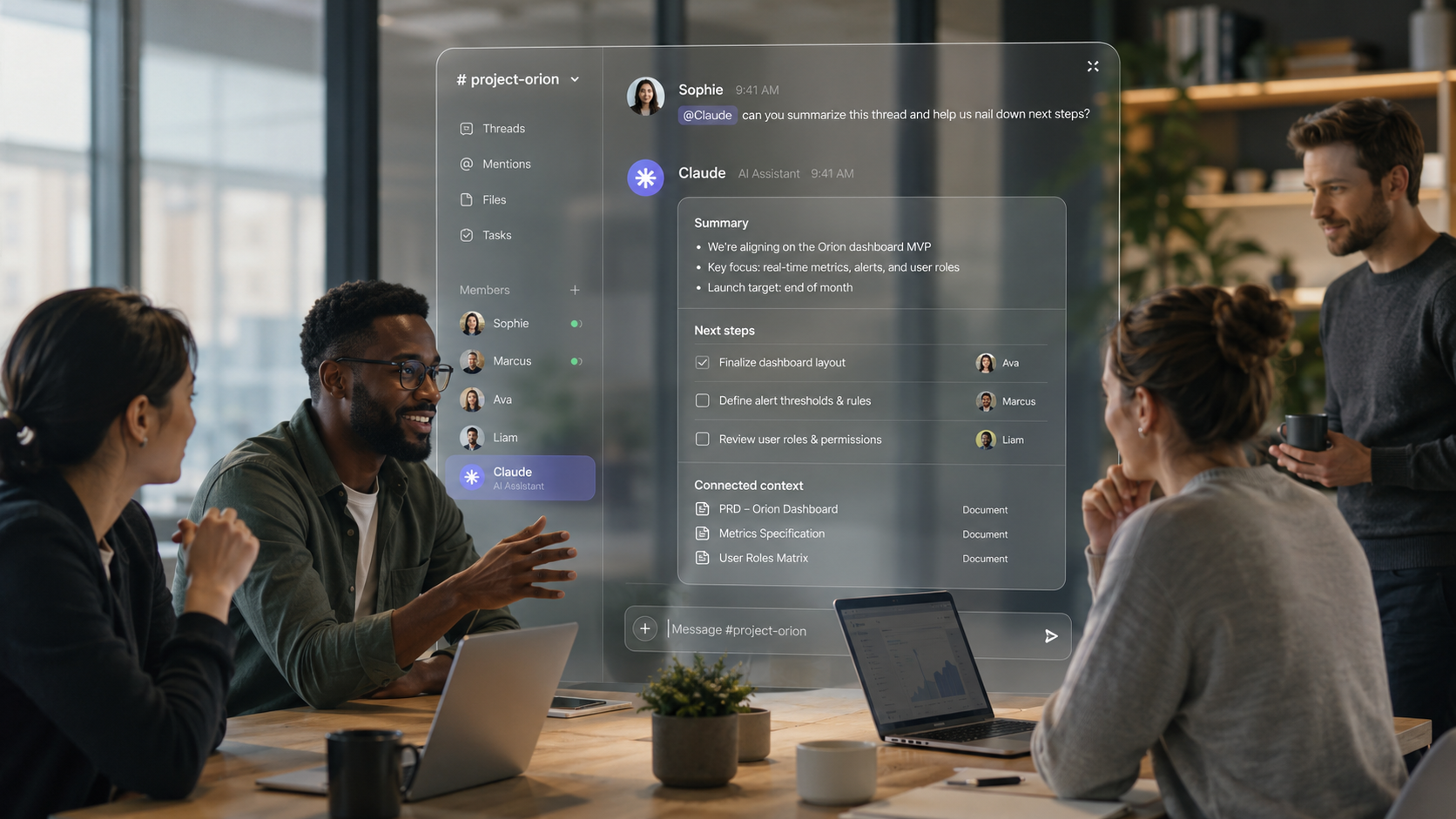
Table of contents
TL;DR
Claude Tag shows a shift from AI as a separate chatbot to AI as an operational coworker embedded directly into team workflows: channels, threads, and business processes. For companies, this means less manual context switching, faster information structuring, and easier delegation of work to AI.
The key change is that AI does not only answer questions. It can participate in teamwork: summarize discussions, identify next steps, detect unresolved topics, and connect information from different sources. This can shorten the path from signal to decision.
At the same time, this model requires new control mechanisms. Companies need to define what data AI can access, what it can remember, who approves its output, and how its impact on processes is measured. The biggest value will go to organizations that treat AI not as a novelty, but as part of the company’s everyday operating system.
Introduction
For the last few years, many companies have treated AI as a tool that sits next to work. An employee opens a separate window, writes a prompt, copies part of a document, waits for an answer, and then manually moves the result back into the place where the actual process happens. This model is useful, but it has one serious limitation: AI is not part of operations. It is an add-on to individual productivity.
Claude Tag points to a different direction. Instead of forcing people to move into a separate interface, AI appears where the team already works: in communication channels, threads, tasks, and ongoing discussions. This is a meaningful shift because it moves AI from the role of “assistant for individual answers” toward the role of an operational coworker that can receive delegated tasks, understand team context, and work asynchronously.
For companies, this is not just a product update. It is a signal that the next stage of AI adoption will be less about answer quality alone and more about where AI is embedded, what data it can access, how it is controlled, and how it fits into team accountability. Language models are no longer just tools for generating content. They are becoming part of the company’s operating system.
Example
Dorian leads a product team responsible for a B2B SaaS platform. On Monday morning, he sees a long thread in the product channel: support is reporting repeated configuration issues, sales is flagging a lost enterprise opportunity, and engineering is discussing a bug that appears only for a specific group of customers.
In the traditional model, Dorian would have to collect information manually from several conversations, ask an analyst for data, push the issue toward engineering, and then prepare a summary for leadership. Each step would require a separate message, a separate context, and often another reminder. The biggest cost would not be the analysis itself, but coordination.
In a model where AI is embedded in the team channel, Dorian can mention the assistant and ask it to prepare a working diagnosis: which complaints repeat, which customer segments are affected, whether the issue has appeared before, and what decisions have already been made. AI does not behave like an external chatbot that needs the entire history pasted into it. It acts more like someone who has been present in the conversation, has seen earlier threads, and can connect them with available tools.
An hour later, Dorian receives a structured thread: hypotheses, gaps in the data, proposed next steps, and a list of people who should confirm specific information. A human still makes the decision. The difference is that the team does not lose half a day just building a shared picture of the situation. AI shortens the distance between signal and action.
From chatbot to team member
The most important change is not that AI can answer inside a communication tool. That would only be a chatbot moved into another window. The key shift is that AI can operate inside a shared team workspace: it can see the discussion, respond in a thread, continue work started by someone else, and produce output that is visible to all participants.
In practice, this changes how work is delegated. Until now, many AI tasks were private and one-off. An employee asked a model for help, received a result, and perhaps shared it with the team. In the new model, the task exists in a team context from the start. Others can see what was assigned, clarify assumptions, correct direction, or take over the thread.
This creates several operational consequences:
-
AI work becomes visible to the team, which makes it easier to assess whether the task was understood correctly. Some of the risk connected with private AI usage outside the process and outside organizational control is reduced.
-
Context does not have to be recreated from scratch, because AI can use information already present in the channel and in tools it has been allowed to access. This reduces repetitive explanations and speeds up execution.
-
The output becomes part of the conversation, rather than a separate artifact detached from the process. This makes it easier to move from analysis to decision, because the team sees both the result and the prior reasoning around it.
This shift matters especially in companies where operational knowledge lives in messengers, tickets, documents, backlogs, and meetings. AI without access to this context may be powerful, but it remains blind to how the organization actually works. AI embedded in teamwork can reduce friction between information, decision, and execution.
Why context becomes an advantage
In business use of AI, the biggest limitation is often not the model itself, but lack of the right context. Even a very capable model will produce a mediocre answer if it does not know how the company defines customers, what the product priorities are, which decisions have already been made, and what technical or legal constraints must be respected.
Claude Tag highlights something that will become increasingly important in AI work: memory and access boundaries. If AI operates inside a specific channel, it can build knowledge about what that team works on. It does not need to ask for the same basic information every time. It can recognize recurring topics, refer back to previous decisions, and better understand internal shorthand used inside the organization.
For companies, this means that advantage will not come only from access to the best model. Three elements will matter more and more:
-
The quality of operational data, because AI can only work with what is available, current, and understandable. Chaotic documentation, outdated instructions, and conflicting decisions will directly reduce the quality of AI output.
-
Clear access boundaries, because not every assistant should see everything. AI supporting sales does not need detailed engineering discussions, and AI supporting engineering should not accidentally expose commercial information.
-
Memory kept in the right context, meaning knowledge should be attached to specific channels, teams, and processes. This makes AI useful without creating one uncontrolled “super assistant” with access to the entire organization.
This moves responsibility for AI adoption from the individual user level to the architecture of work. Companies will need to design not only prompts, but also AI operating environments: where the assistant is present, what it remembers, what tools it can invoke, and who is accountable for its output.
Asynchronous work with AI
One of the most interesting directions is asynchronicity. In a simple chatbot model, the user asks a question and waits for an immediate answer. In an operational model, AI can accept a task, break it into steps, work within the process, and return with a result when it has completed the analysis or gathered the necessary information.
This resembles delegating work to a team member rather than querying a search engine. The practical difference is that a person does not need to supervise every step, but they do need to define the expected result, scope of responsibility, and acceptance criteria clearly.
Asynchronous AI work can be especially helpful in tasks that are important but often delayed because they require many small steps:
-
Analyzing threads and support tickets, where AI can collect recurring issues, classify them, and indicate which ones have the greatest customer impact. The team receives a ready starting point for decision-making instead of a raw list of messages.
-
Preparing decision materials, where AI can combine data from multiple sources, identify gaps, and create a first version of a recommendation. The manager still owns the decision, but does not start from a blank page.
-
Monitoring stalled work, where AI can notice that a thread has not been closed, lacks an owner, or contains a critical unanswered question. This reduces the risk that important issues disappear into communication noise.
-
Running multiple analyses in parallel, where different AI instances can work on separate tasks at the same time. For the organization, this means higher throughput for analytical and conceptual work without immediately increasing headcount.
This does not mean full autonomy without control. Asynchronous AI requires clear rules: when it may act independently, when it must ask for approval, which actions are only recommendations, and which ones can trigger real changes in company systems.
Impact on the company
Deploying AI as an operational coworker affects many parts of the organization at once. It is not a tool only for IT or product teams. If AI operates where work happens, it changes how information flows, how tasks are prioritized, and how decisions are made.
Operations and processes
In operations, the biggest value is friction reduction. Companies often lose time not because they lack competence, but because information is fragmented, decisions are not closed, and responsibility for next steps is unclear.
AI embedded in team channels can help in several areas:
-
Structuring scattered signals, because it can connect information from conversations, tickets, and documents into one working diagnosis. This reduces the risk that the team reacts to a single loud case instead of a real pattern.
-
Accelerating handoffs between teams, because AI can prepare context for the next person or department. Instead of passing a topic through a long and chaotic thread, the company can create short, coherent summaries.
-
Detecting unfinished issues, because AI can notice threads without decisions, missing owners, or repeated unanswered questions. This is especially important in organizations that move quickly and manage many parallel initiatives.
Finance and costs
From a financial perspective, AI inside team channels is not free acceleration. There are usage costs, administration costs, integration costs, and the risk of uncontrolled consumption. At the same time, the potential time savings can be significant if AI takes over part of the analytical, coordination, and documentation work.
The main question is therefore not “how much does AI usage cost?” but which processes have enough business value to justify AI support?
-
Cost should be measured against business impact, not the number of generated answers. Value appears when AI shortens decision time, reduces errors, or increases team throughput.
-
Budget limits should be set at the level of teams and use cases, because different departments will use AI with different intensity. A support channel may generate different consumption than a strategic leadership channel.
-
ROI should be analyzed at the process level, because a single AI response rarely shows the whole picture. The real savings may appear only when the entire cycle becomes shorter: from problem, through analysis, to decision and execution.
Customer and customer experience
For customers, the impact may be indirect, but very real. If AI helps a company understand issues faster, connect signals from support and product, and prepare better responses, the organization can react to the market more quickly.
This matters especially in companies that collect large amounts of feedback but struggle to process it effectively. AI can help turn scattered customer voices into concrete actions:
-
Faster identification of recurring problems allows the team to focus on root causes instead of only handling individual tickets. This improves product quality and reduces pressure on support.
-
Better preparation of customer responses can increase communication consistency. AI can collect the context, but a human should approve the tone, decision, and commitments made to the customer.
-
Connecting sales, product, and support perspectives helps reveal which issues affect revenue, retention, or satisfaction. Product priorities become less intuition-driven and more grounded in operational signals.
Team and management
AI as a coworker also changes how work is managed. Managers will need to learn how to delegate not only to people, but also to AI systems. This requires different habits: clearly defining the goal, scope, constraints, and expected output format.
For teams, this changes the daily rhythm of work:
-
Some coordination work will move to AI, which can free people from low-value tasks. At the same time, the ability to evaluate AI output and give direction will become more important.
-
Transparency of AI work will matter for trust, because the team needs to see who assigned the task, what data AI used, and what exactly it produced. Without this, confusion and unclear accountability can quickly appear.
-
The leader’s role will shift toward designing the work system, not only assigning tasks. Leaders will need to decide which processes are worth supporting with AI, where human judgment is required, and how to measure output quality.
Risks and control
The closer AI gets to daily work, the more important access control, auditability, and accountability become. This is a natural consequence of embedding models in operational tools. If AI only drafts text, the risk is limited. If it has access to data, channels, code, or execution tools, the risk becomes organizational.
Companies should pay particular attention to several areas:
-
Overly broad data access, which can lead to unnecessary mixing of contexts. AI supporting one team should not automatically know information that is not needed for its tasks.
-
Unclear accountability for output, because it is easy to assume that if “AI prepared the analysis,” no one needs to review it as an owner. In practice, every business decision should still have a human owner.
-
Automation of bad processes, because AI can accelerate chaos as well. If a company has outdated data, conflicting instructions, or unclear rules, the model may simply produce faster, polished, but wrong conclusions.
-
Hidden usage costs, which appear when every channel starts delegating many tasks without prioritization. Limits and usage monitoring are needed not to block adoption, but to direct it toward areas that create real value.
Good control should not kill usefulness. The goal is not to create such a restrictive system that nobody uses it. The goal is to provide a safe operating space in which teams can delegate work to AI while the organization still understands what is happening.
How to prepare the organization
Companies that want to use AI as an operational coworker should start not with technology, but with processes. The best deployments will happen where the organization clearly understands which tasks it wants to delegate, what data is needed, and how AI output quality will be evaluated.
A good starting point is to choose a few processes with frequent, repetitive, and visible problems. The goal is not a spectacular pilot, but a practical place where AI can show value quickly.
It is worth moving through several steps:
-
Identify processes with high coordination cost, meaning those where a lot of time is spent collecting information, summarizing threads, reminding people about tasks, and preparing decisions. These are natural areas for AI embedded in team communication.
-
Define AI roles for specific teams, rather than creating one general assistant for the whole company. AI for support, sales, product, or engineering should have different knowledge, tools, and restrictions.
-
Set access and audit rules before broad deployment, because cleaning up permissions later is harder. Administrators should know which channels are covered by AI, what data is available, and who can review the history of actions.
-
Introduce a standard for delegating tasks, so users know how to formulate requests. A good AI assignment should include the goal, context, expected output format, constraints, and quality criteria.
-
Measure impact across the whole process, not only user satisfaction. The best metrics are time to decision, number of unresolved threads, quality of summaries, reduction in manual work, and shortening of the cycle for handling a specific issue.
The most important lesson is simple: AI embedded in teamwork will not fix an organization that does not understand how it works. But it can strongly amplify a company that has sensible processes, clear accountability boundaries, and the willingness to redesign everyday work routines.
Summary
Claude Tag is interesting not because it lets users mention AI in a communication tool. Its importance lies in showing where work with AI models in companies is heading. AI will no longer be only a separate tool for individual productivity. More and more often, it will become a participant in processes, present in channels, threads, tools, and tasks.
For organizations, this means a change in thinking. AI adoption will not be just about buying access to a model and encouraging employees to experiment. It will require designing AI roles, access control, memory rules, cost limits, and new accountability standards.
The greatest value will go to companies that treat AI not as a gadget, but as an operational component. One that can structure information, accelerate decisions, support teams, and reduce coordination costs. At the same time, the greatest risk will be carried by organizations that let AI into daily work without clear boundaries, owners, and control mechanisms.
The lesson from Claude Tag is practical: the future of AI in business will not play out only in models. It will play out in how well companies embed AI into the real work of people.

Sebastian Kaczmarek
CTO at MDBootstrap and CogniVis AI / Co-founder of MDBS - 10 years shipping hard tech, now building private AI that turns document chaos into structured data.
Author of Learn Bosque Programming book / YouTube creator / ex StackOverflow contributor.