
Google DeepMind loses key people. What it says about the new AI economy
The AI market is no longer just a competition between models. Advantage increasingly depends on talent, speed, capital, compute and the ability to turn research into working products.
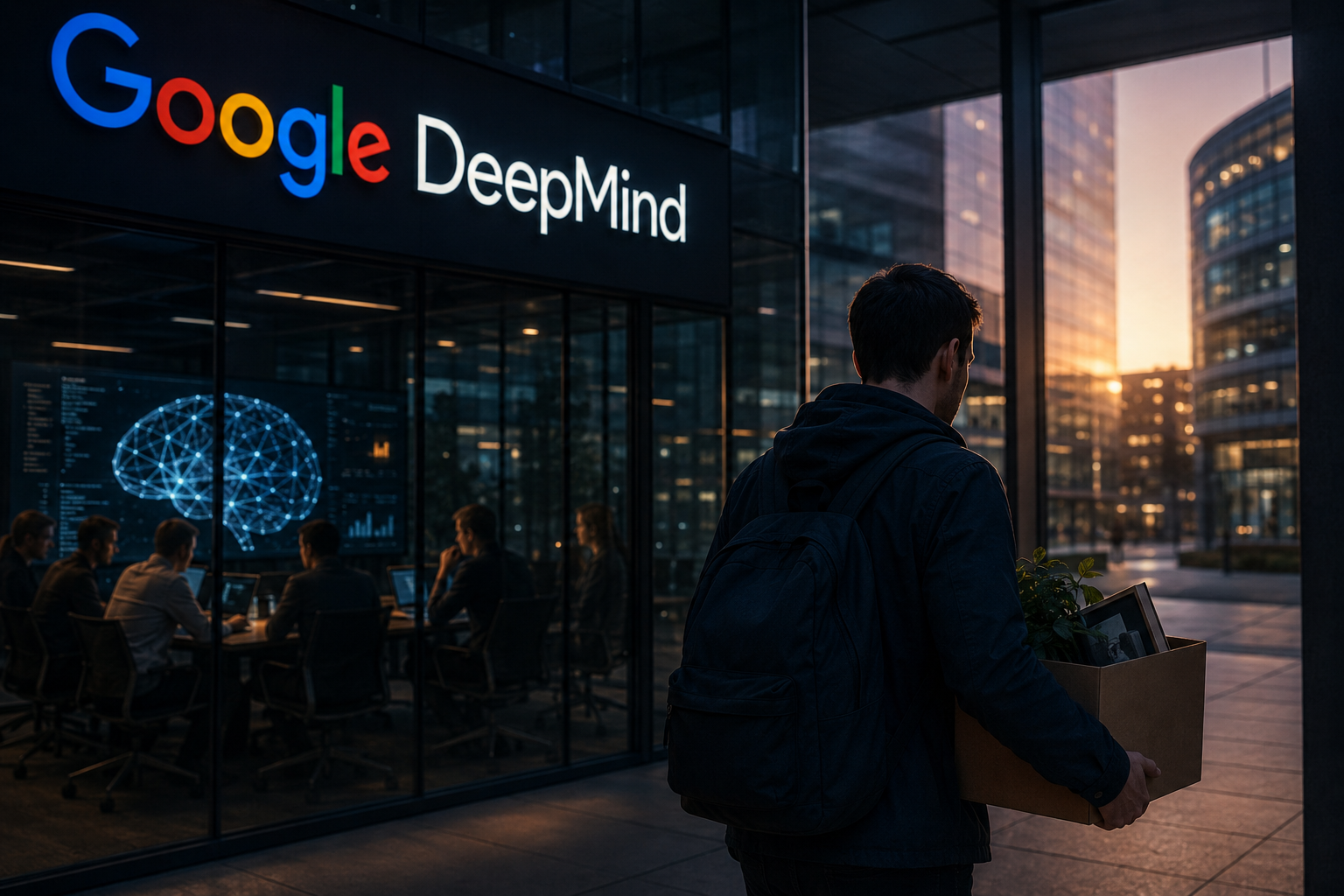
Table of contents
TL;DR
Google DeepMind remains one of the most important AI organizations in the world, but the departure of key people shows that the economics of artificial intelligence have changed. Top specialists increasingly choose companies that offer more agency, faster deployment, participation in future value and a direct impact on the product.
For businesses, this means that AI advantage no longer depends only on budget, brand or access to technology. Operating model, decision speed, access to data and infrastructure, and the ability to turn experiments into real business deployments are becoming just as important.
Introduction
The departure of several key researchers from Google DeepMind is not just another labor-market story from the technology sector. It is a sign of a much broader shift: AI is entering a stage where advantage no longer depends only on company size, research history or access to capital, but also on an organization’s ability to turn knowledge into products, processes and measurable business impact.
For years, large technology companies had a natural advantage. They had infrastructure, reputation, research budgets, strong brands and teams capable of attracting the best specialists. In AI, that advantage still matters, but it is no longer enough. The strongest people do not automatically choose the organization with the biggest resources. Increasingly, they choose the place where they can build faster, ship faster and have a larger share in the value they help create.
That is why the story of Google DeepMind, Anthropic and OpenAI matters far beyond the frontier AI market. It shows that AI is changing compensation, operating models and technology decision-making. If even the largest AI labs need to fight to retain critical people, every company building AI capabilities should ask itself a direct question: are we creating an environment where our best people actually want to stay?
Example
Elian leads a machine learning team at a large insurance company. His team spent eighteen months building a model that detects claims with a high probability of requiring manual escalation. Technically, the model worked well. The issue was not the algorithm. The issue was the organization around it.
First, the team needed approval from IT to connect the model to operational systems. Then compliance requested additional documentation. After that, the customer operations team asked for a broader redesign of the claims workflow. Finally, the steering committee decided that the project should be merged into a larger transformation program planned for the following year.
During that period, one of Elian’s strongest engineers accepted an offer from a smaller AI company building automation tools for insurers. The salary was attractive, but it was not the deciding factor. What mattered was the promise that her work would reach users in weeks, not after another year of internal alignment.
To the insurance company’s leadership, the resignation looked like an HR issue. To Elian, it was something much bigger. The company had not only lost an employee. It had lost part of its ability to learn quickly and turn AI into operational advantage.
The same mechanism is visible in the frontier AI market. People do not leave only because someone offers more money. They leave for environments where their work becomes product, impact and value faster.
Why departures from DeepMind matter
At first glance, the departure of a few high-profile researchers may not seem to threaten a company as large as Google. An organization of that scale still has thousands of engineers, massive infrastructure, proprietary hardware, access to data, global distribution and a strong product portfolio. All of that remains true.
The problem is that in AI, not every person carries the same strategic weight. In traditional technology organizations, the departure of one employee can often be absorbed through process, documentation, recruitment and redistribution of responsibilities. In AI research and model development, the impact of individuals can be much larger. They shape research directions, model architectures, experimentation culture and technical priorities.
The significance of such departures can be seen across several levels that matter for business organizations as well:
-
At the technology level, the company loses knowledge that cannot be fully captured in documentation. In AI, a large part of advantage comes from experimental judgment: which approaches tend to work, which fail, how to stabilize training, how to diagnose model behavior and how to make decisions under uncertainty.
-
At the product level, the company may lose people who know how to convert research into features that users can actually adopt. When those people leave, the gap between model capability and market-ready product can become wider.
-
At the culture level, departures send a signal to people who stay. When key colleagues move to competitors, employees start reassessing their own future. The question becomes whether the organization is still the best place to build breakthrough AI systems.
-
At the market level, these moves influence perception. Investors, partners, customers and candidates read them as signals. Even if the company remains fundamentally strong, the market may begin to ask whether it is losing momentum in one of the most important technology races of the decade.
For large organizations, this is an uncomfortable lesson. Scale helps, but it does not guarantee speed. Brand attracts talent, but it does not automatically retain people who want to build at startup pace. Budget creates options, but it does not remove organizational friction if decision-making is slow, fragmented or politically complex.
The new economics of AI talent
The AI talent market no longer behaves like a standard IT labor market. In the traditional model, companies competed through salary, employer brand, project scope and stability. AI has added another factor: the asymmetric impact that a small number of people can have on the value of an entire organization.
If a researcher, model architect or technical leader can materially accelerate the development of a product worth billions, their negotiating position changes. They are no longer simply employees executing tasks inside a larger structure. They become carriers of strategic advantage.
This shift creates practical consequences for organizations:
-
Compensation stops being only an HR cost and becomes an investment in a strategic capability. Top AI specialists are not paid only for current output. They are paid for the possibility of creating products that the company might not be able to build without them.
-
The market rewards high-agency environments, because the strongest people want to see the direct effect of their work. If an organization offers prestige but blocks impact through committees, slow processes and unclear ownership, it becomes vulnerable to faster-moving competitors.
-
Retention depends increasingly on the organization’s learning speed. People stay where experiments lead to decisions and decisions lead to deployments. If a company mainly produces slide decks, roadmaps and internal backlogs, its best people will eventually lose patience.
-
Intellectual capital is becoming less attached to company brand. In the past, working at a major research lab could be the obvious peak of a career. Today, many specialists see more value in co-building a company, product or platform that is still forming its market position.
This matters for executives. In AI, it is not enough to “have a team.” The organization needs an operating model that allows the team to move at the right speed. Talent without agency quickly becomes talent that competitors can hire away.
Capital changes career decisions
In a traditional public company, equity compensation is usually tied to the share price of a mature organization. That can still be attractive, but the upside has limits. A large company can continue to grow, but it rarely offers the same risk-reward profile as a fast-growing private AI company.
This is where AI-native companies have a powerful advantage. For top specialists, an offer is not only about salary. It can also mean joining a company at a stage where its valuation may still grow dramatically. That changes the psychology of career decisions.
This is not simply about greed or chasing the largest package. It is about the logic of a market in which a handful of companies can build infrastructure, products and customer relationships at global scale within a relatively short period of time. If a specialist believes their work can increase the value of such a company, it is rational to expect participation in that value.
For business leaders, this has several implications:
-
Compensation packages become strategic tools, not just pay policies. Companies that want to attract AI capabilities need to think about compensation in terms of impact on enterprise value, not only salary bands.
-
Large organizations struggle to compete on prestige alone, because prestige does not compensate for the absence of future upside. The strongest candidates compare not only annual salary, but also the potential value scenario three, five or seven years ahead.
-
Non-technology companies do not need to copy Silicon Valley packages, but they do need to understand the mechanism. If they cannot offer large equity upside, they need to offer something else: real influence, autonomy, fast deployment, a clear mandate and access to meaningful business problems.
-
Rigid pay structures can become a strategic constraint. If an organization treats AI specialists according to the same compensation grid as general IT roles, it may quickly discover that it is not competing in the same market.
Large technology companies are in a difficult position. They have money, but their ownership structure and market maturity limit the potential upside for employees. Smaller AI companies carry more risk, but they offer something that mature corporations cannot easily copy: a stake in an uncertain but potentially enormous future value pool.
Compute as an organizational currency
In AI, compute is not just infrastructure. It is budget, priority and internal power translated into technical capacity. A team with access to significant compute can experiment faster, train larger models, test more hypotheses and reach conclusions more quickly. A team with limited compute loses momentum.
This matters because many companies still treat AI infrastructure as a technical expense. For teams building models, however, compute is a strategic resource. Whoever decides on compute often decides which product directions move forward.
In practice, access to compute affects several areas of the company:
-
Operations and processes gain or lose speed depending on whether teams can test ideas quickly. If experiments wait for weeks because environments, approvals or cost decisions are delayed, the organization learns slower than competitors.
-
Finance is directly involved because training, fine-tuning and operating models can be expensive. The real problem is not cost itself, but the lack of clarity about which experiments are tied to meaningful business value. Without priorities, a company can either overspend on low-value projects or block the ones that could create advantage.
-
Product and customer experience are affected through delivery speed. If a team cannot develop and improve models quickly, customers wait longer for better personalization, support automation, recommendations or workflow assistance.
-
Teams and HR interpret access to compute as a signal of trust. For an AI specialist, limited resources can mean that their project is not truly important, even if leadership says otherwise in strategy presentations.
-
Management needs to treat compute allocation like investment allocation. The goal is not to give every project unlimited resources. The goal is to make decisions quickly, transparently and in connection with measurable business outcomes.
This is one of the most important lessons for companies deploying AI. They may hire good people, buy tools and announce an AI strategy, but if teams lack access to data, environments, infrastructure and decision rights, the impact will remain limited. AI does not progress in presentations. It progresses through loops of experimentation, deployment and measurement.
Why company structure can beat brand
Large technology companies have resource advantages, but they also pay for those advantages with complexity. The larger the organization, the more stakeholders, dependencies, legal reviews, security requirements, product constraints and internal priorities it must manage. Some of that complexity is necessary. The problem starts when the structure protects the company from risk so effectively that it also protects it from innovation.
AI-native companies operate differently. They are built around one central battlefield: models, AI products and their applications. They do not need to protect as many legacy business models. They do not have to align every decision with multiple mature product lines. They can accept risk faster because their main market opportunity is AI itself.
This structural difference has practical consequences:
-
Product decisions are shorter, because fewer groups need to agree that a feature fits the existing ecosystem. As a result, teams can test what works for users and abandon what does not more quickly.
-
Research sits closer to product, reducing the classic gap between lab work and deployment. When researchers see their work reach users quickly, motivation and feedback quality both improve.
-
Priorities are clearer, because the company is concentrated around one strategic direction. In larger organizations, AI may compete for attention with advertising, cloud, devices, operating systems, search and many other business areas.
-
The risk of cannibalization is lower, because younger companies do not have as much existing revenue to protect. A large company must ask whether a new AI product could weaken an existing margin source. A startup more often asks how to capture the market as quickly as possible.
-
The working culture is closer to experimentation than administration. That does not mean a lack of responsibility. It means more tolerance for iteration, mistakes and fast changes in direction.
This is why brand alone is no longer enough. For top people, working at a famous company is attractive only when it also gives them real influence. If a large organization moves more slowly than the market, its brand can begin to feel less like an advantage and more like a constraint.
What this means beyond Big Tech
Most companies do not compete directly with Google DeepMind, Anthropic or OpenAI. They do not build frontier models, hire the most famous AI researchers or spend billions on training infrastructure. But the mechanisms visible in this competition are highly relevant for ordinary organizations.
Business AI will increasingly depend on the ability to attract and retain people who understand both technology and company processes. These people will not always be model researchers. More often, they will be automation architects, data leaders, AI product owners, integration engineers, governance specialists and people who can translate operational needs into AI-supported systems.
Companies should pay attention to several areas:
-
Operations need AI close to daily work, not isolated inside a central innovation unit. If the AI team is separated from sales, customer service, logistics or finance, projects will target problems that are too generic and will be deployed too slowly.
-
Finance should evaluate AI through measurable value, not only tool cost. The real question is which processes, once automated or augmented, will improve margins, shorten sales cycles, reduce errors or free expert time.
-
Management must give teams a clear mandate. AI should not be a side project handled between other responsibilities. If the organization expects results, it needs owners, budget, priorities and clear decision rules.
-
IT should move from being only an infrastructure gatekeeper to becoming an implementation partner. Security control is necessary, but if every experiment requires a long approval cycle, the organization will lose the learning-speed race.
-
HR needs to understand that AI roles do not always fit old job descriptions. People who combine technology, product and process knowledge will become increasingly valuable, even when they do not map neatly to existing salary bands.
-
Sales and marketing should treat AI as a way to redesign work, not just generate content. The largest value may come from lead qualification, communication personalization, buying-signal analysis and better decision support for sales teams.
The conclusion is straightforward: companies that want to benefit from AI need to build not only technical competence, but also an organizational environment capable of deploying change quickly. Otherwise, the best people become frustrated and projects remain stuck at the pilot stage.
How executives should read this signal
For executives, the AI talent story is primarily a warning against overly simple thinking about transformation. It is not enough to buy licenses, hire a few specialists and launch an innovation program. If the organization does not change how decisions are made, AI will get stuck in the same places where earlier digital projects got stuck.
The most important questions are not only about technology. They are about the company’s operating model.
-
Do AI teams have real access to business problems? If they work on detached use cases, their solutions may be technically correct but operationally irrelevant. The strongest projects emerge where technology meets a specific business pain point.
-
Are deployment decisions made quickly enough? Long approval cycles weaken AI advantage because models, tools and user needs change faster than traditional project plans.
-
Does the company know which AI projects are strategic and which are experimental? Without that distinction, the organization either blocks too much through caution or funds too many scattered initiatives with little impact.
-
Can the best people see a path to impact? AI specialists do not want only to build models and present results. They want to see their work change a process, product, decision or customer experience.
-
Does the compensation system reflect the value of AI roles? Not every company has to offer startup-style equity, but every company needs to understand that critical AI capabilities may require a different approach to motivation and retention.
-
Can the organization manage risk without paralysis? AI requires governance, but governance cannot mean stopping action. Strong companies build safety frameworks that enable responsible progress rather than becoming a convenient excuse for doing nothing.
From the executive perspective, the key point is not simply that people are moving between AI labs. The key point is that the best specialists choose organizations that give them more agency. The same dynamic will appear at smaller scale in banking, manufacturing, logistics, retail, healthcare and professional services.
Summary
Departures from Google DeepMind show that the AI market is moving from fascination with models to competition over people, operating structure and deployment capability. Models still matter, but they do not create advantage on their own. Advantage comes from an organization’s ability to connect talent, compute, data, product, processes and business decisions into one effective operating loop.
For large technology companies, the challenge is to combine scale with speed. For AI startups, the opportunity is to attract people who want more influence and a larger share in future value. For companies outside Big Tech, the lesson is that AI is not only a technology project. It is a test of the operating model.
The practical conclusion is clear: a company that wants to retain strong AI people must give them more than tools and strategy statements. It must give them a clear problem to solve, access to data, resources, decision rights, fast deployment paths and a sense that their work has real business impact.
The new AI economy does not reward only the biggest organizations. It rewards those that can move faster, learn more effectively and organize work so that technology does not remain trapped at the experiment stage. That is why the Google DeepMind story matters far beyond AI labs. It is a warning for every organization that wants to build advantage with artificial intelligence while still managing it according to old rules.

Sebastian Kaczmarek
CTO at MDBootstrap and CogniVis AI / Co-founder of MDBS - 10 years shipping hard tech, now building private AI that turns document chaos into structured data.
Author of Learn Bosque Programming book / YouTube creator / ex StackOverflow contributor.