
Microsoft Frontier Company: a new model for AI deployment in large organizations
Microsoft signals that enterprise AI is moving beyond experiments and into operational engineering built around business outcomes, trust, and the protection of organizational intelligence.
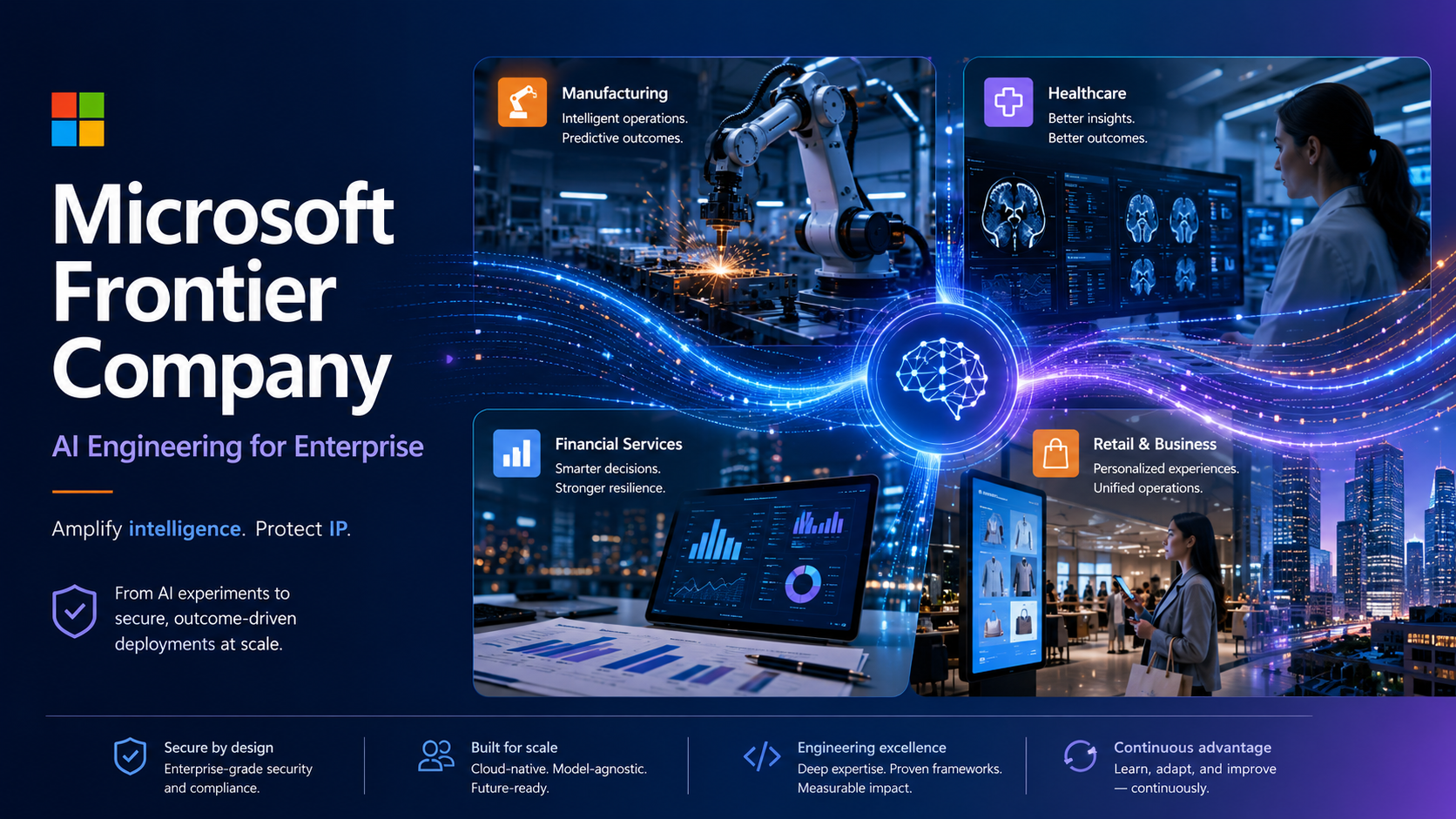
Table of contents
TL;DR
Microsoft Frontier Company shows that AI deployment in large organizations is entering a more mature phase. The focus is no longer only on testing chatbots, copilots, or isolated productivity tools. What matters now is designing AI around specific processes, measurable outcomes, and the protection of organizational knowledge.
The main lesson for companies is practical: AI does not scale simply because an organization buys more licenses. It scales when it is embedded in operations, integrated with data, governed by clear rules, and measured against business results. Companies that treat AI as an operational layer, not just a technology add-on, will have a better chance of turning AI investment into real business advantage.
Introduction
Microsoft Frontier Company is not just another announcement about a new AI tool or another layer of messaging around copilots. The more important signal is different: AI deployment in large organizations is moving from experimentation into operational engineering.
Over the last few years, many companies have tested AI in fragmented ways. One business unit launched a chatbot for customer support, another experimented with marketing content, IT built an internal proof of concept, and the board kept asking when the return on investment would become visible. The problem was that many of these efforts were too scattered, too technical, and too weakly connected to real business outcomes.
Microsoft is now communicating something more specific: enterprise AI should be deployed close to processes, data, decisions, and the people responsible for results. The point is not only to provide access to a language model. The point is to build systems that strengthen organizational knowledge, accelerate work, improve decision quality, and protect what matters most to the company: data, know-how, processes, and competitive advantage.
This is an important shift because the largest barriers to enterprise AI adoption rarely sit in the technology alone. They sit in process integration, ownership of outcomes, trust in the system, cost control, data security, and the ability to improve the solution after launch. Microsoft Frontier Company is a response to precisely that problem.
Example
Imagine a logistics company operating across several countries. Its operations director, Nadia, is responsible for delivery reliability, transport costs, and the quality of service delivered to business customers. The company has large volumes of data: shipment statuses, delay history, complaints, carrier pricing, warehouse reports, client agreements, process documentation, and thousands of messages exchanged between regional teams.
On paper, the organization is data-driven. In practice, Nadia sees something else. Each region has its own spreadsheets, its own process exceptions, and its own interpretation of why deliveries are delayed. Customer service sees the consequences of problems, but not always the causes. Warehouses see bottlenecks, but do not always have access to sales forecasts. Finance sees rising costs, but often only after the damage is already visible.
The company launches an AI project. The first idea is simple: a chatbot that answers questions about shipments and procedures. After a few weeks, it becomes clear that this is not enough. The chatbot helps with simple tasks, but it does not solve the main issue: the organization does not have a shared system for learning from operational data.
A more mature AI deployment would look different. The team would not start with the question: “Which model should we use?” It would start with: Which process needs to improve, and how will we measure the effect? For example: reducing complaint handling time by 30%, lowering delays on selected routes, detecting cost risks earlier, or generating recommendations for planners.
In that scenario, AI is not an add-on to work. It becomes a layer that supports operational decisions. The system analyzes data, detects recurring patterns, recommends actions, learns from human decisions, and is continuously improved. The critical point is that the company’s knowledge does not leak outside the organization and does not become a generalized advantage for others. AI should amplify the company’s intelligence, not consume it.
What Microsoft is really signaling
The core message is straightforward: companies no longer want only to buy access to AI models. They want deployments that work inside their real operating environment, with their processes, data, regulatory constraints, and accountability for outcomes. Microsoft is responding by creating an organization focused on AI transformation delivered together with clients.
In practice, this means shifting the emphasis from product to deployment engineering. A large organization does not only need an interface to a model. It needs a team that can understand the industry, integrate AI into workflows, secure the environment, measure the results, and improve the system after launch.
This approach can be broken down into several elements with direct business relevance:
-
AI must be tied to measurable outcomes, not just to the fact that the technology has been launched. For the business, what matters is whether a process becomes faster, cheaper, more accurate, or easier to scale.
-
Deployment must happen close to the client, because universal solutions often remain at the level of generic capability. Only contact with real data, exceptions, and organizational constraints shows what actually needs to be redesigned.
-
The system must improve after deployment, because business processes are not static. Products, customers, regulations, costs, sales channels, and organizational structures change, which means AI must be maintained as a living operational component.
-
Organizational knowledge must remain under the client’s control, because data, procedures, decisions, and industry context are often more important than the model itself. They determine whether AI creates an advantage or merely automates generic tasks.
This matters because many earlier AI projects stopped at the demonstration stage. The system looked impressive in a presentation, but once brought into the organization, it lacked access to the right data, did not understand process exceptions, was not accountable for outcomes, or did not fit security policies.
Why this matters for large organizations
In a small company, AI deployment can sometimes mean launching a SaaS tool and changing a few work habits. In a large organization, the subject is much more complex. Every change touches many departments, systems, stakeholders, security requirements, and accountability models.
That is why Microsoft Frontier Company should be read as a response to the problem of scale. Enterprise AI cannot remain only a personal productivity tool. It has to enter the processes where costs, revenue, risks, and management decisions are created.
The impact of this approach can be seen in several areas of the company:
-
Operations and processes gain the most potential when AI works on real workflows, not beside them. If the system can analyze tickets, documents, decision history, and transactional data, it can help reduce handling time, eliminate repetitive work, and detect the points where processes get stuck.
-
Finance starts looking at AI through the lens of return on investment rather than innovation alone. The costs of models, infrastructure, integration, maintenance, and organizational change must be compared with specific effects such as lower operating costs, higher margins, faster customer service, or reduced risk of errors.
-
Management gets the opportunity to improve decision quality, but only if AI is supplied with the right context. A model without access to current data and without an understanding of organizational rules can generate attractive answers that are not suitable for business decisions.
-
IT and security have to move from the role of blocking gatekeeper to the role of architect of safe deployment. This includes access control, observability, auditability, cost governance, and the ability to respond when the system behaves in unexpected ways.
-
Business teams need to learn how to work with AI in a process-driven, not accidental, way. Giving people access to a tool is not enough if they do not know when to trust a recommendation, when to verify it, and how to report errors so the system can improve.
This is why mature AI deployment is closer to operational transformation than software installation. Technology matters, but it is not enough. Processes, owners, metrics, governance, and continuous improvement are required.
AI as an operating layer for business processes
The most practical change is that AI is no longer treated as a standalone tool for generating text. In large organizations, it is increasingly becoming a layer that connects data, applications, users, and decisions. That means AI is starting to function as an operating layer for business processes.
This does not mean the model replaces all existing enterprise systems. It means AI can become an interpretation and action layer above them. An employee does not need to manually search ten systems, compare documents, copy data, and prepare recommendations from scratch. AI can gather context, identify patterns, suggest the next step, and trigger part of the work inside existing systems.
This approach changes how processes are designed:
-
Processes become less linear, because AI can analyze many signals in parallel. In customer service, the system can simultaneously check ticket history, contract terms, order status, similar cases, and possible escalation paths.
-
Decisions can be made faster, because the employee receives prepared context instead of raw data. The difference is that AI does not only retrieve information; it helps structure and apply it in a specific situation.
-
Organizational learning can become more systematic, because decisions, corrections, and feedback can feed future iterations of the solution. If the system is designed properly, the organization does not lose knowledge when a project ends or an employee leaves.
-
Automation becomes more selective, because not every step has to be fully autonomous. In many processes, a human-in-the-loop model creates more value, with AI preparing a recommendation and a person approving actions that carry higher risk.
For leadership teams, this requires a different way of thinking about investment. It is not enough to ask how many AI licenses the company has bought. The better questions are: which processes have been redesigned, how operational metrics have changed, how many decisions are supported by AI, and where measurable advantage is being created.
Protecting organizational intelligence
One of the strongest elements in Microsoft’s message is the emphasis on protecting organizational intelligence. This concept matters because it describes a real enterprise AI problem. Many organizations are not only afraid of data leakage. They are also afraid of losing control over what makes them different.
Organizational intelligence is not one file or one database. It is the sum of many elements: procedures, expert experience, decision history, customer data, industry-specific knowledge, risk assessment methods, sales models, operational documentation, and informal expertise that has accumulated inside teams over many years.
Deploying AI without protecting this layer can create several risks:
-
The risk of commoditizing competitive advantage, when unique company data and practices are used in a way that does not strengthen only that organization. For the business, this may weaken the difference between itself and competitors.
-
The risk of losing internal trust, when employees and managers do not know where data entered into AI tools actually goes. If teams do not have clear rules, they either use tools informally or avoid AI completely in important processes.
-
Regulatory and contractual risk, especially in industries with strong confidentiality requirements. Customer data, medical records, financial information, production data, and legal documentation cannot be treated as ordinary training material.
-
Operational risk, when the system generates answers based on incomplete or poorly secured context. The organization may then make decisions faster, but not necessarily better.
That is why protecting organizational intelligence is not an add-on to AI deployment. It is a condition for scaling. The closer AI gets to critical processes, the more important data control, permissions, audit, information separation, and clear learning rules become.
Model-diverse AI instead of a single-model strategy
Microsoft also emphasizes an approach in which a company is not locked into one AI model. This is a practically important direction because, in enterprise environments, one model will rarely be the best choice for everything. Customer service, legal document analysis, coding, industry-specific data processing, and high-scale low-cost tasks all have different requirements.
A model-diverse approach means the organization can match the model to the scenario. In theory, this sounds technical. In practice, it is a business decision because it affects cost, risk, quality, and vendor dependence.
For companies, this creates several consequences:
-
Better alignment between cost and task value, because not every use case requires the most expensive or most advanced model. Some processes can be handled by cheaper specialized models, while premium models can be reserved for high-value or highly complex tasks.
-
Lower vendor lock-in risk, because the organization does not base its entire AI strategy on one model, one provider, or one technology roadmap. This is especially important in a market where model capabilities are changing quickly.
-
Greater regulatory flexibility, because some data or processes may require specific processing conditions. The company can then adapt the architecture to legal, industry, and data residency requirements.
-
The ability to build specialist models, which may better understand the language of a specific industry, document type, or process logic. In many cases, the advantage does not come from using the largest model, but from combining the right model with the organization’s own context.
This approach requires mature architecture. The company has to know which models are used, in which processes, with what data, at what cost, and with what level of risk. Without that management layer, model diversity can quickly turn into chaos.
The role of partners and industry experts
AI deployment in large organizations increasingly requires the combination of three capabilities: technology, industry knowledge, and change management. A technical team alone is not enough if it does not understand the reality of the process. The business alone is not enough if it cannot translate needs into data architecture, integrations, and control mechanisms.
That is why experts working close to the client matter. They can translate the general capabilities of AI into specific operational scenarios. In practice, this means people who can enter a process, understand constraints, design a solution, deploy it, and improve it based on results.
This approach matters especially in several situations:
-
When the process is highly industry-specific, a generic AI model is not enough without context. Risk analysis in finance, production planning, patient service, and inventory management in retail all work differently.
-
When the organization has many legacy systems, AI deployment requires integration with the existing architecture. This is often the hardest part of the project, because data is fragmented, inconsistent, or locked inside systems built over many years.
-
When the way of working has to change, technology must be embedded into the daily routines of teams. If people do not know how to use AI recommendations, who is accountable for the decision, and how to report errors, the system will not reach its full value.
-
When leadership expects outcomes, the project needs clear metrics and business owners. Without them, AI remains an innovation cost rather than a mechanism for improving results.
In this sense, Microsoft Frontier Company shows that the AI market is entering a phase of engineering and operational services. The platform still matters, but advantage will increasingly depend on who can guide clients through the change and deliver results in real processes.
What companies should do next
For companies watching this direction, the worst reaction would be to treat it as just another announcement from a large technology provider. Whether an organization uses Microsoft, another ecosystem, or its own architecture, the signal is clear: AI must be designed around business outcomes and the protection of organizational intelligence.
The practical starting point does not need to be complicated. Before scaling more tools, companies should clarify several decisions.
The most important actions are:
-
Select processes where AI can create measurable impact, instead of launching initiatives only because they are technologically attractive. A good candidate is a process that is repetitive, costly, information-heavy, and clearly connected to customer experience, cost, or revenue.
-
Define the organizational intelligence that must be protected, because without this, it is difficult to set rules for working with AI. The company should know which data, procedures, documents, decision models, and expert knowledge represent its real advantage.
-
Build AI governance, covering roles, permissions, model usage rules, audit, security, and mechanisms for responding to errors. Governance should not become bureaucracy; it should be the layer that enables safe scaling.
-
Measure cost and return on investment, because AI creates not only benefits, but also costs related to models, infrastructure, integration, maintenance, and training. Without financial discipline, it is easy to build a solution that is technically impressive but weak from a business perspective.
-
Design deployments as improvement loops, not one-time launches. An AI system should include mechanisms for collecting feedback, improving answer quality, updating context, and monitoring outcomes.
-
Prepare people for a shift in their roles, because AI changes not only tools but also responsibility within the process. Employees need to understand when AI is an assistant, when it recommends a decision, and when it can automatically execute an action.
Companies that treat AI only as a productivity tool may achieve short-term gains. Companies that treat AI as an operational layer built on data, processes, and trust have a chance to build a much more durable advantage.
Summary
Microsoft Frontier Company is an important signal for the enterprise AI market. It shows that the largest deployments will no longer be judged by the number of chatbots launched, but by whether AI actually improves processes, protects organizational knowledge, and delivers measurable outcomes.
The most important shift is from thinking about the “model” to thinking about the business system. The model is only one component. Data, integrations, security, governance, costs, accountability, feedback, and continuous improvement matter just as much.
For large organizations, this is a very practical lesson. AI does not scale by itself. It scales when it is embedded in processes, measured through business outcomes, and designed to amplify the company’s unique intelligence instead of scattering it.
In that sense, Microsoft’s new direction clearly shows where the market is heading. The demonstration phase is slowly ending. A new phase is beginning, where AI must deliver results, operate safely inside the organization, and become part of the company’s operating model.

Sebastian Kaczmarek
CTO at MDBootstrap and CogniVis AI / Co-founder of MDBS - 10 years shipping hard tech, now building private AI that turns document chaos into structured data.
Author of Learn Bosque Programming book / YouTube creator / ex StackOverflow contributor.