
OpenAI launches “Patch the Planet”: AI to help fix open source vulnerabilities
The initiative shows that AI in cybersecurity does not have to stop at detecting vulnerabilities. The real value is in validation, prioritization, patches, testing, and deployment.
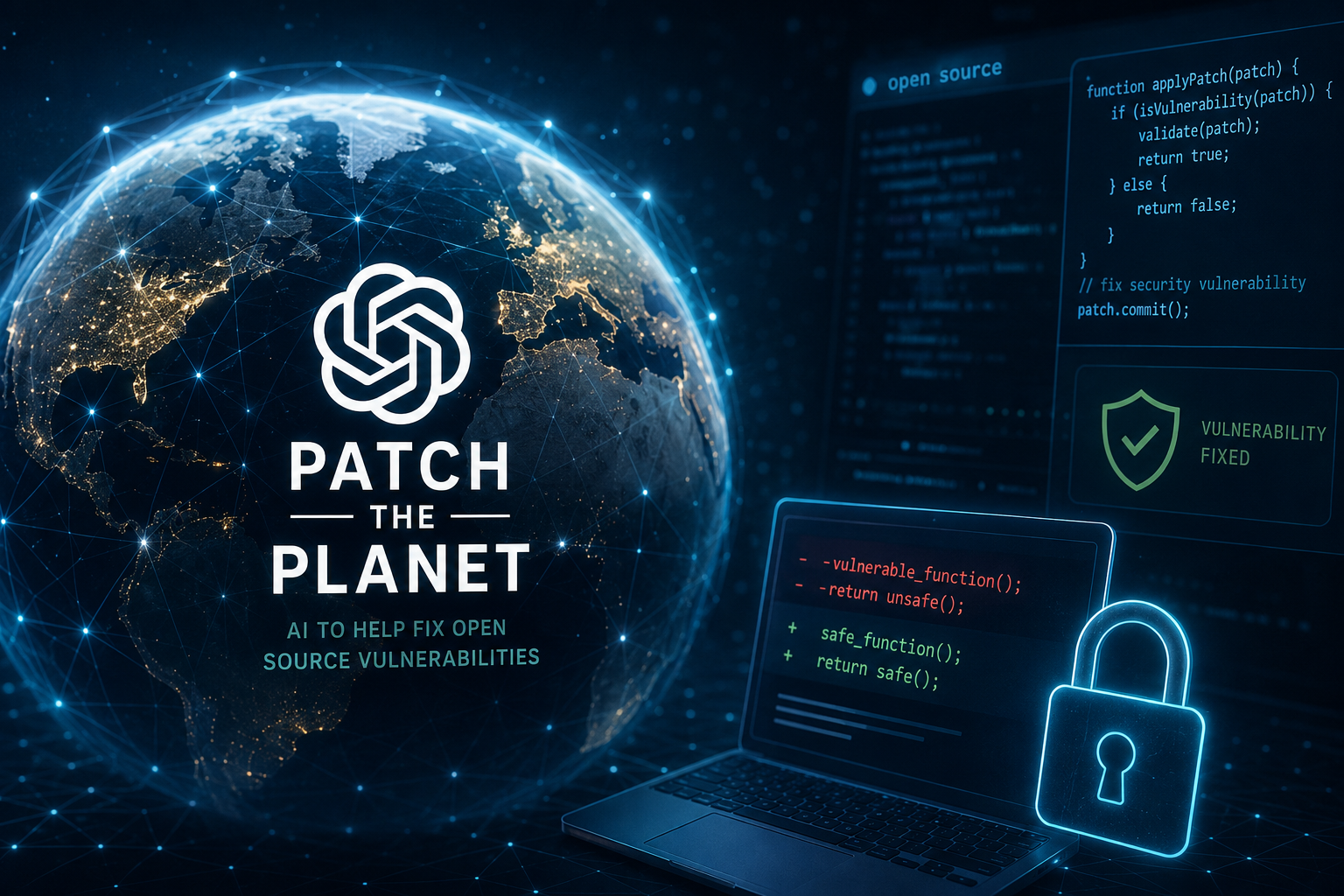
Table of contents
TL;DR
OpenAI’s “Patch the Planet” program shows that AI in cybersecurity is moving beyond simply detecting vulnerabilities and toward helping teams actually fix them. The main value is not in generating more alerts, but in shortening the path from a reported issue to a verified, tested, and safely deployed patch.
For companies that rely on open source, this is an important operational signal. Organizational security increasingly depends on components maintained outside the company, often by small maintainer teams. AI can help increase their capacity, but it does not replace code review, testing, technical ownership, or business accountability.
The key takeaway: the advantage will not belong to organizations that detect the most vulnerabilities, but to those that can turn confirmed risk into safely deployed fixes the fastest.
Introduction
Open source is now part of almost every organization. Even companies that do not build their own technology products rely on libraries, frameworks, servers, networking tools, cryptographic components, CI/CD systems, and packages created outside their own teams. This means that a company’s security increasingly depends on code it did not write, but uses every day.
OpenAI’s “Patch the Planet” program is interesting not simply because it presents AI as another tool for finding vulnerabilities. That would matter, but it would not be enough. The more important shift is operational: AI is being positioned to support the broader workflow around vulnerabilities — from analysis and validation to patch preparation, testing, documentation, and coordinated remediation.
That shift matters in practice. In cybersecurity, finding a bug does not solve the problem. Sometimes it creates a new one: someone has to determine whether the report is real, how serious the risk is, whether the issue can be reproduced, how to prepare a fix, how to avoid breaking existing behavior, and when the patch can be safely deployed.
For business leaders, this is an important signal. The greatest value of AI in security may not be the number of vulnerabilities it discovers, but the reduction of time between detection and a safe fix. That segment of the workflow is one of the biggest burdens today for open source maintainers, security teams, and IT departments.
Example
Nadine leads a platform team at a mid-sized SaaS company serving customers in the insurance sector. Her team does not build its own cryptographic engine, HTTP server, or network client from scratch. It relies on popular open source libraries, because that is how most sensible technology organizations operate.
The problem starts on a Monday morning, when the security team receives information about a potential vulnerability in a library used across several services. The alert appears in Jira, Slack, and the dependency management tool at the same time. At first glance, it looks serious, but nobody knows whether it affects the company’s actual configuration.
Before making a decision, Nadine needs answers to several questions:
- Does the vulnerability affect the version used by the company, or only an older branch of the library?
- Is the vulnerable function actually called in the company’s products?
- Is there an available fix, or does the team need to prepare a temporary mitigation?
- Will the update break compatibility with other components?
- Does the company need to notify customers, or is an internal update enough?
In an ideal world, these answers would appear quickly. In reality, the team spends hours checking dependencies, reading changelogs, running tests, and contacting service owners. The vulnerability report itself does not solve the issue, because the most important work begins only after the alert arrives.
This is where an approach like “Patch the Planet” becomes meaningful. AI can help analyze code, compare variants, generate regression tests, prepare patch proposals, and filter out false leads. Humans still make the decisions, but they no longer have to do all the preparatory work manually.
For Nadine, the difference is very concrete. Instead of asking, “Do we have another vulnerability?”, she can get to the better question faster: “Do we have a confirmed issue, a verified fix, and a safe deployment path?”
Why finding vulnerabilities is not enough
In recent years, security tools have become very effective at generating signals. Dependency scanners, SAST tools, DAST systems, bug bounty programs, fuzzing, and automated code analysis can produce large volumes of reports. The problem is that more alerts do not automatically mean better security.
In practice, organizations often hit an operational bottleneck. Every report must be checked, understood, and placed in the context of a specific environment. A vulnerability may be real but unreachable in a given configuration. It may have a high technical score but a low business impact. It may also look dangerous, only to turn out to be a duplicate or a tooling error.
The biggest cost is not only in finding the vulnerability. It is in the entire remediation workflow. That workflow usually includes several stages that require time and experience:
- Technical validation means checking whether the vulnerability can be reproduced and whether the report is not a false positive. Without this step, the team may waste time on issues that have no real impact on the system.
- Business impact assessment requires connecting the vulnerability to products, customers, data, and processes. The same weakness can mean something very different in a test environment and in a service that handles payments or regulated data.
- Prioritization is necessary because teams cannot fix everything immediately. Without priorities, the organization becomes reactive and starts managing security through pressure instead of risk.
- Patch preparation requires more than a code change. A good fix removes the issue without introducing new defects or breaking existing functionality.
- Testing and deployment determine whether the patch can actually reach production. In many companies, this is where the biggest delays occur, because the work requires coordination across teams.
That is why automating vulnerability discovery alone is not enough. If AI only produces more reports, maintainers and security teams receive a larger backlog. But if AI helps move issues through the full path from report to fix, it can change the actual capacity of the security system.
What the Patch the Planet approach changes
The most interesting part of the program is the shift in emphasis from “let’s find as many vulnerabilities as possible” to “let’s help confirmed issues get fixed”. The difference may seem small, but it changes the operating model.
In a traditional model, the maintainer of an open source project may receive a vulnerability report that requires additional analysis. If the project has a small team or is maintained mostly by volunteers, every such report becomes a burden. Even a well-prepared report takes time, and a poorly prepared report can pull attention away from more important work.
A model that combines AI, security experts, and maintainers creates a chance for a more complete workflow. AI can accelerate analysis, but humans filter the results, confirm the risk, and align the work with the project’s standards. This matters because maintainers must retain control over what enters their codebase.
In practice, this model can include several layers of work:
- AI as an analytical tool can scan code faster, look for similar bug patterns, generate hypotheses, and suggest test directions. This increases coverage without requiring a person to manually analyze every part of the system.
- Security experts as a quality filter are needed to separate real issues from noise. Models can be very useful, but without human validation, the risk of false positives remains too high.
- Maintainers as decision owners decide how a given fix fits the project, whether it aligns with the architecture, and when it can be merged. This reduces the risk that external support forces an unacceptable implementation style onto a project.
- Testing and automation as lasting value matter because the best outcome is not just one fixed vulnerability. The real value also includes better test infrastructure, better regression detection, and a repeatable process.
From the perspective of companies using open source, the key point is that the security of shared components cannot depend only on the goodwill of a small group of people. A more systematic support model is needed, where AI increases throughput and experts protect quality.
Impact on companies using open source
For business teams, this topic may seem distant because the program concerns maintainers and open source projects. In reality, the impact is direct. If a company uses popular components, its operational risk depends on how quickly and effectively those components are maintained.
It is worth looking at this impact from several angles, because open source security is not only an IT problem.
Operations and business continuity
In operations, the most important effect is reduced uncertainty. When information about a vulnerability appears, the company needs to quickly determine whether the issue affects its services and what action is required.
Several effects matter most here:
- A shorter response time to vulnerabilities means teams can move faster from alert to decision. This reduces situations where a technical issue blocks the roadmap or forces emergency maintenance windows.
- Higher-quality fixes in foundational components reduce the risk that a dependency update solves one problem but creates another. For companies operating services that must remain continuously available, this is a very practical benefit.
- Fewer unclear reports help teams focus on real risk. If maintainers receive better-validated reports, fixes can reach projects faster and in a more predictable way.
Finance and risk cost
The cost of a vulnerability is not limited to the work of a developer updating a library. It also includes downtime, escalations, audits, customer communication, incident analysis, and potential regulatory consequences.
From a financial perspective, three areas are especially important:
- Less reactive work lowers the cost of handling urgent problems. Every hour spent on emergency vulnerability analysis is time taken away from product development, customer support, or system modernization.
- Lower risk of costly incidents comes from closing known issues faster. Companies are often not attacked through entirely new techniques, but through vulnerabilities that were already known and simply not patched in time.
- More predictable security budgets become possible when an organization can turn vulnerability handling into a process. Instead of funding constant firefighting, the company can invest in automation, testing, and dependency management.
Customer trust
Customers rarely care whether a company uses a specific open source library. They care whether the service works, whether their data is safe, and whether the vendor can respond responsibly to risk.
In this area, credibility is what matters most:
- A faster response to known vulnerabilities strengthens customer trust, especially in regulated sectors. Customers do not expect a complete absence of vulnerabilities, but they do expect a professional remediation process.
- Better communication when risk appears becomes possible when the company has clear information: what the issue affects, whether it is exploitable, which systems are impacted, and when the fix will be deployed.
- Lower risk of service disruption directly affects customer experience. Even when a vulnerability does not lead to a data breach, emergency updates can create instability that customers experience as a business problem.
Technology and architecture
For technology teams, programs that support open source security are a signal that dependency management must become part of architecture, not an afterthought at the end of the delivery process.
The most important changes concern daily engineering practice:
- Dependencies must be visible and up to date, because without that visibility the company cannot quickly assess vulnerability impact. A poor view of open source components means the team is delayed before the response even begins.
- Regression tests become critical, because updating a library cannot be an act of faith. The stronger the test automation, the easier it is to deploy fixes without paralyzing product teams.
- The update process must be regular, not only emergency-driven. Companies that avoid dependency updates for long periods later pay a much higher price for each fix, because changes accumulate and become harder to deploy safely.
What this means for IT and security teams
For IT and security teams, the main lesson is straightforward: AI does not replace the security process, but it can radically change its throughput. There is one condition — the organization must know where AI should help and where responsibility still belongs to humans.
In practice, teams should treat AI not as a magic scanner, but as support for specific stages of work.
The most useful applications appear where there is a lot of repetitive analysis but expert supervision is still required:
- Triage of reports can be supported by AI when the team needs to compare a vulnerability with system configuration, version history, and the way a library is actually used. This does not remove the need for decision-making, but it helps filter out clearly irrelevant reports faster.
- Variant analysis is especially valuable because many weaknesses appear in similar code patterns. AI can help identify places where the same type of issue appears in another module or project.
- Test generation can reduce the time needed to confirm the problem and protect against its return. In security, a fix without a test often means that a similar issue can reappear in a future version.
- Patch proposal preparation can accelerate the work, but it should not bypass review. Code generated or suggested by AI must go through the same quality standards as any other code.
- Documentation and technical communication can be partially automated, helping teams coordinate across functions. Clear descriptions of risk and changes make decisions easier for product owners, compliance teams, and leadership.
The biggest organizational change is that security teams will need to become better at designing workflows. Having an AI tool is not enough. Teams need to define who approves results, who accepts fixes, what escalation criteria apply, and how the effectiveness of the overall process is measured.
Risks and limitations
It is worth staying realistic. AI in cybersecurity increases defensive capacity, but it does not eliminate risk. Models can help find serious issues, but they can also generate false positives, misjudge severity, or suggest patches that do not fit the project’s architecture.
The biggest mistake would be to treat AI as an automatic security authority. In a well-designed process, AI accelerates work, but it does not take responsibility for technical and business decisions.
The most important limitations are practical:
- False positives will remain a problem, especially at large analysis scale. If the organization does not have a validation process, AI can increase noise instead of reducing it.
- A patch may be technically correct but operationally wrong if it does not account for compatibility, performance, maintainability, or project standards. In security, closing the vulnerability is not enough; the stability of the system also matters.
- Models may not understand business context, so assessment of customer impact, regulatory exposure, SLA obligations, and company processes still requires human judgment. A technical vulnerability does not carry the same level of risk in every organization.
- Automation can create a false sense of control if the company measures the number of discovered issues instead of time to remediation, patch quality, and real risk reduction.
- Dependence on external tools requires governance, especially when analysis involves code, infrastructure, or sensitive data. Companies must clearly define what information can be processed by AI tools and under what conditions.
These are not arguments against AI. They are arguments for mature implementation. The organizations that gain the most value will combine automation with responsible review, strong dependency management, good testing, and a clear decision model.
How companies should prepare
Programs such as “Patch the Planet” send an important signal to companies: open source security will be increasingly supported by AI, but the benefits will not appear automatically. Organizations need foundations that allow them to use better fixes, better reports, and better automation quickly.
The first step is not buying another tool. The first step is organizing knowledge about what the company uses and how it responds to risk.
In practice, companies should start with several areas:
- Build an up-to-date view of dependencies, because without it the company cannot quickly assess vulnerability impact. The organization should know which open source components are used, in which versions, in which products, and by which teams.
- Define a clear vulnerability handling process covering triage, priorities, owners, timelines, and escalation paths. Without a process, even the best tool becomes another source of alerts.
- Strengthen automated tests, especially in areas that depend on critical libraries. The easier it is to test an update, the faster the company can deploy a fix without destabilizing the service.
- Measure time from detection to remediation, not only the number of vulnerabilities found. This metric better shows whether the organization is actually reducing exposure to risk.
- Define rules for AI use in code analysis, so teams know what data can be processed, who approves the results, and what requirements must be met by a patch generated with model support.
- Treat open source as part of the supply chain, not as a free technical add-on. This means regular updates, criticality assessment, and conscious dependency risk management.
The most mature companies will treat this as an operating model change. AI can accelerate analysis and remediation, but business value appears only when the organization can turn that speed into a real deployment process.
Summary
“Patch the Planet” shows an important direction for AI in cybersecurity. The point is no longer only for models to find more vulnerabilities. The point is to help teams move through the entire defense cycle: discovery, validation, impact assessment, patching, testing, and deployment.
For the open source ecosystem, this can become meaningful support, because many critical projects are maintained by small teams with limited capacity. For companies, it is a reminder that their security depends on shared infrastructure they often do not see every day, but without which their products and processes could not operate.
The practical conclusion is clear: AI will not solve open source security on its own, but it can significantly increase the capacity of the people who do. The condition is to combine models with expert validation, strong testing, responsible deployment processes, and maintainer control.
Companies should treat this trend as a signal to act. It is worth organizing dependencies, update processes, tests, and AI usage rules in security now. In the next phase of cybersecurity, the advantage will not belong to organizations with the most alerts, but to those that can turn confirmed risk into a safely deployed fix the fastest.

Sebastian Kaczmarek
CTO at MDBootstrap and CogniVis AI / Co-founder of MDBS - 10 years shipping hard tech, now building private AI that turns document chaos into structured data.
Author of Learn Bosque Programming book / YouTube creator / ex StackOverflow contributor.