
Wimbledon and IBM: a practical lesson in implementing AI in a large organization
Wimbledon shows that AI in a large organization does not start with a flashy feature, but with data, architecture, processes, and quality control.
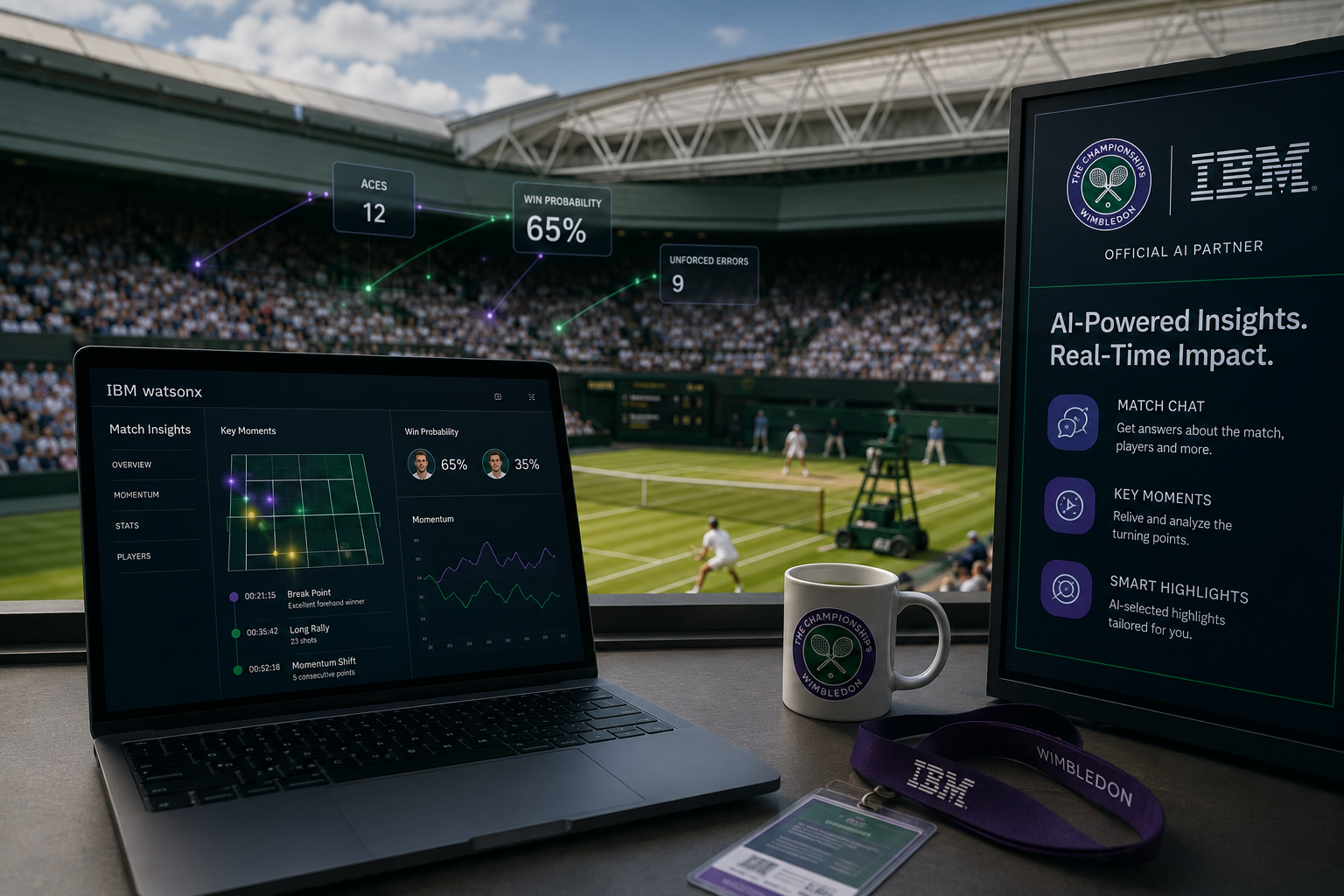
Table of contents
TL;DR
Wimbledon and IBM show that a successful AI implementation in a large organization is not about adding a flashy chat feature to an existing website. The real value appears when AI connects live data, archives, editorial workflows, analytics, and quality control into one coherent operating system.
The key business lesson is simple: AI works well only when the organization has structured data, clear accountability, and processes designed for real-time use. Without that foundation, a model may generate answers, but it will not truly support better decisions.
For companies, this means AI projects should not start with choosing a tool. They should start with a sharper question: which decisions are currently too slow, too expensive, or made without enough context. Only then can AI become practical support for operations, customer service, sales, marketing, IT, and management.
Introduction
AI implementations in large organizations are often described through the most visible feature: an assistant, a chat interface, an automated summary, or a recommendation engine. This is understandable because these are the elements the end user can actually see. The problem is that the real value of AI is not created in the interface, but in the operating system behind it: the data, rules, integrations, processes, and control mechanisms that allow the feature to work reliably, quickly, and in the right context.
Wimbledon is a useful example of this approach. The AI tools developed with IBM are not just an add-on to a website or mobile app. They are part of a broader digital modernization effort that covers match data, historical archives, multimedia content, analytical models, editorial workflows, and quality assurance.
The most interesting part is not simply that a fan can ask a question about a match or view an analysis of key moments. The more important point is that the organization is building an operational model for AI use: one that combines live data, historical knowledge, language that users can understand, and mechanisms that reduce the risk of misleading or low-quality responses.
For companies outside sport, this is a very practical lesson. AI in business does not have to mean futuristic scenarios. It can mean better customer service, faster decision-making, more structured organizational knowledge, workflow automation, and new digital services. The condition is clear: the organization has to treat AI not as a single tool, but as part of how the company operates.
Example
Leonie manages customer support at a company that sells specialist equipment for industrial facilities. The company has thousands of product documents, service ticket histories, manuals, engineering notes, training recordings, and CRM data. In theory, the organization has a large knowledge base. In practice, support agents still waste time searching for information across several systems.
During a customer call, an agent can see the order number, but not always the full history of previous technical issues. A service engineer understands the technical background, but may not see the latest commercial communication. A manager notices that support requests are increasing for a specific product series, but cannot quickly connect that trend with documentation, production batches, and recurring customer questions.
Leonie does not need an “AI chat” as a novelty feature. She needs a system that can answer a much more practical question: what has happened in this case so far, what matters most, and what decision should be made now.
The implementation therefore does not begin with choosing a language model. It begins with structuring the underlying sources. The company maps documents, defines relationships between products, tickets, and customers, and decides which data can be used automatically and which requires approval. Only then does it build an assistant that supports agents during customer conversations.
The result is not that AI “writes nicer answers.” The result is that agents understand context faster, customers do not have to repeat the same story, and the organization starts seeing patterns that were previously hidden across disconnected systems. This is the same mechanism visible in large sports events: the value of AI depends on how well data, processes, and user experience are connected.
AI as an operational layer
In many companies, artificial intelligence is still treated as a separate initiative: a pilot project, an IT experiment, or a tool tested by an individual team. This approach quickly shows its limits. AI can generate an answer, but it may not have access to the right context. It can summarize a document, but it may not know whether the document is current. It can help a user, but it may not be connected to the process that leads to an actual decision.
The Wimbledon example points in a different direction. AI works as a layer that connects several areas at once: match data, statistics, player history, editorial content, multimedia, and the needs of a user following an event through a website or app. This is not only a “conversational overlay.” It is an operational mechanism that helps process events in real time.
For companies, this requires a change in thinking. AI should not be added at the end of a process, after systems, data, and decisions have already been designed. It should be considered as part of the organization’s operating model.
The practical consequences are important:
-
Processes need to be designed around information flow, not only around tasks performed by people. AI works best when it can access current data, understand its context, and return an output exactly where the user is making a decision.
-
Teams need to define where automation ends and human responsibility begins. In a large organization, it is not enough to say that “the model generated something.” The company needs to know who owns data quality, who approves rules, who monitors errors, and who decides when the system should be changed.
-
Technology must support scale, not just a demo. A pilot can work on a small data sample, but a production environment requires stability, monitoring, integrations, security, and predictable operating costs.
In this sense, AI stops being a tool “for generating content.” It becomes a layer that allows the organization to interpret data faster and respond better to changing conditions.
Data, context, and archives
One of the biggest mistakes in AI projects is assuming that the model itself will solve the organization’s knowledge problem. It will not. If data is scattered, outdated, inconsistently described, or difficult to connect, AI will only expose the mess faster. The model can generate a response, but it cannot be sure that it is using the best available source.
This is why archives and data architecture matter so much. In an event like Wimbledon, content is not just a simple collection of files. Articles, images, videos, statistics, metadata, player profiles, and match history form a network of relationships. Only when that network is structured can AI use it effectively.
In companies, the situation is very similar. An organizational archive may include proposals, contracts, presentations, technical documentation, meeting recordings, customer tickets, sales reports, risk analyses, and procedures. Each asset has value, but only when these assets are connected into a logical system does the company gain a real advantage.
The impact of well-prepared data is visible across several areas:
-
Operations become more consistent, because employees no longer have to manually reconstruct context from multiple places. If the system can connect customer data, interaction history, and current case status, the team works faster and makes fewer mistakes.
-
Finance benefits from reducing repetitive work, because less time is spent searching, copying, and manually comparing information. The savings do not come only from automating a single task, but from reducing friction across the whole process.
-
Customer experience improves when the organization understands the context of the conversation from the first interaction. The customer no longer feels that they are dealing with another isolated department that has no knowledge of previous arrangements.
-
Management gets a clearer view of the situation, because operational data can be analyzed not as separate reports, but as connected signals. This makes it easier to identify trends, risks, and points where a process is breaking down.
The key point is that AI does not replace data discipline. AI requires data discipline, and then makes it possible to use that discipline at scale.
Live event operations
Live coverage is one of the more demanding environments for AI. Information changes quickly, users expect immediate answers, and a mistake can be visible to a very large audience. In sport, there is also an emotional dynamic: a fan does not want to search through tables while a match is unfolding. They want to understand what just happened and why it matters.
This is where tools such as Match Chat or Key Moments show a practical direction for AI development. The goal is not only to deliver data, but to interpret it. A point won, the length of a rally, or a double fault are facts. But the user often wants more: did that moment change the direction of the match, did it affect the probability of winning, and does it fit a broader pattern of play?
The same applies to business. Companies have more and more live data: sales activity, app traffic, delivery status, user behavior, support tickets, infrastructure load, marketing campaigns, payments, and security alerts. Access to this data is not enough. Organizations need a layer that explains what matters right now.
In practice, such a layer can support different functions:
-
Sales can respond faster to changes in customer behavior, for example when a key account becomes less active, delays a buying decision, or contacts support more often. AI can indicate not only that something changed, but also what may have caused it and what next step is worth considering.
-
Marketing can interpret campaigns while they are still running, instead of waiting for a post-campaign report. The system can show which messages are starting to work, where acquisition costs are increasing, and which segments are behaving differently than expected.
-
Customer support can prioritize cases by relationship impact, not only by ticket order. If AI understands customer history, account value, and the emotional tone of the interaction, it can help the team respond more appropriately.
-
IT and operations can detect incidents faster, because a single alert often does not say much. Only when logs, user reports, and recent system changes are connected does the organization see whether it is dealing with a local issue or a risk to the whole service.
The biggest value of real-time AI is that it shortens the distance between an event and the understanding of its meaning. Data is no longer only a record of what is happening. It becomes active decision support.
Quality control and trust
The closer AI operates to the end user, the more important quality control becomes. In a live environment, a company cannot rely only on the fact that the model “usually answers well.” It needs rules, supervision, confidence assessment, testing, and clear boundaries around what the system is allowed to say.
This is especially important in large organizations, where reputation, compliance, and customer trust have measurable value. A wrong answer from an assistant can seem like a small mistake, but in practice it may lead to a bad decision, a complaint, a legal escalation, or loss of brand credibility.
That is why AI implementations should include governance from the beginning. Not as a document added after a successful pilot, but as an integral part of the project. Governance does not mean slowing innovation down. It means building a system that can develop without losing control.
Companies should break quality control into several levels:
-
Input data control should define which sources AI can use and which sources take priority. If the system uses documents, databases, and archives, it needs to know which data is current, approved, and relevant to a specific case.
-
Response control should cover rules for tone, information scope, and situations in which the system should refuse to answer or hand the matter over to a human. This is especially important in legal, financial, medical, technical, and relationship-sensitive areas.
-
Operational risk control should monitor how AI behaves in real use. What matters is not only model errors, but also usage patterns: what users ask, where the system struggles with context, and which responses need correction.
-
Responsibility control should clearly identify process owners. AI cannot belong to no one. Someone must be responsible for data, quality, security, compliance, and future development.
Trust in AI is not created because the system sounds convincing. It is created when the organization can explain how the system works, what it relies on, and where its limits are.
Technology debt
AI implementations quickly reveal technology debt. If a company has spent years building systems, integrations, and databases without a coherent architecture, an AI model will hit those problems immediately. It will not know which source is correct. It will not connect data that has no shared identifiers. It will not automate a process that exists only as informal knowledge in the heads of a few employees.
This is why platform modernization is often more important than the AI feature itself. An organization that wants to use artificial intelligence in production has to reduce technical friction: organize data, simplify integrations, reduce dependency on outdated systems, and bring critical competencies closer to internal teams.
Technology debt affects AI in very specific ways:
-
It increases implementation costs, because the team must fix the foundations before building the user-facing feature. A project that was supposed to be a quick pilot turns into a series of cleanup tasks.
-
It lowers answer quality, because AI relies on inconsistent or incomplete data. Even the best model will not produce a reliable result if the context is wrong or fragmented.
-
It makes scaling harder, because a solution may work in one team but cannot be easily transferred to other areas of the company. Each new use case then requires separate integrations and workarounds.
-
It increases vendor dependency risk, especially when the organization does not understand its own architecture or control critical data elements. AI can then deepen existing dependencies instead of reducing them.
This is why companies should treat AI projects as an opportunity to review their operational architecture. The point is not to “fix everything” before implementing artificial intelligence. The point is to understand which parts of the infrastructure are critical for quality, security, and scale.
Lessons for companies
The most important lesson from this type of implementation is simple: AI creates value when it solves a concrete operational problem. In Wimbledon’s case, that problem is managing a large volume of data, content, and interactions in real time. In a company, it may be customer support, sales analysis, service assistance, knowledge management, risk monitoring, or back-office automation.
It is not worth starting with the question: “Which model should we implement?” A better starting point is: which decisions in our organization are currently too slow, too expensive, or made without enough context. Only then does it make sense to choose the right architecture, data layer, and tools.
Companies planning a similar approach should pay attention to several practical principles:
-
Start with the process, not the interface. A chatbot can be a convenient way to communicate, but it is not a strategy. First, the organization needs to understand where information is created, who uses it, which decisions depend on it, and what currently blocks the flow of work.
-
Build a layer of organizational context. AI needs to know what products, customers, documents, events, and relationships mean inside the company. Without this, it will answer generally, not operationally.
-
Design features around the moment of use. AI for a board member reviewing a monthly report looks different from AI for a support agent during a customer call, and different again from AI for an IT team responding to an incident. Value appears when the system supports the user exactly at the decision point.
-
Introduce governance before scaling. Quality control, permissions, auditability, confidence assessment, and human escalation should be part of the project from the beginning. Without this, every successful pilot can become a production risk.
-
Measure business impact, not only tool usage. The number of AI queries does not say much by itself. More important metrics include shorter handling time, fewer errors, higher conversion, better customer retention, lower operating cost, and faster response to problems.
-
Treat AI as an organizational capability. A single feature may age quickly, but the ability to connect data, processes, models, and quality control will remain useful across many parts of the business.
The biggest mistake is searching for one spectacular use case that is supposed to prove the value of AI across the whole organization. In practice, durable value comes from many well-designed use cases that improve the daily work of teams.
Summary
Wimbledon and IBM show that a mature AI implementation is not about adding an intelligent assistant to an existing platform. It is about changing how the organization collects data, interprets events, delivers content, and supports users in real time.
The most important business lesson is that AI is not a shortcut around difficult operational work. On the contrary, it forces the company to organize data, processes, responsibility, and technology. Only then can it become real decision support rather than an impressive demonstration.
Companies that want to use AI in practice should look at examples like this not through the lens of sport, but through their own challenges: fragmented information, slow decisions, overloaded teams, and rising customer expectations. That is where AI has the highest potential.
The goal is not for every organization to build its own version of Wimbledon live coverage. The goal is to understand the principle: the best AI implementations connect data, context, process, and accountability into one working system. That is the difference between a technology experiment and real operational change.

Sebastian Kaczmarek
CTO at MDBootstrap and CogniVis AI / Co-founder of MDBS - 10 years shipping hard tech, now building private AI that turns document chaos into structured data.
Author of Learn Bosque Programming book / YouTube creator / ex StackOverflow contributor.